

💬 “My students have zero independent skills. Should I even be doing centers or stations?”
This is one of the most common (and honestly, most important) questions upper elementary teachers ask when it comes to centers or stations.
And I get it.
Because when your students struggle to stay focused, rush through work, or rely on you for every single step, the idea of turning them loose during centers can feel like a recipe for chaos.
Here’s what I want you to know up front:
❌ You don’t need perfectly independent students to make centers work.
✅ You do need strong routines, clear expectations, and tasks that help them build independence over time.
Let’s break down exactly how to make that happen.
What Exactly Do I Mean by Centers or Stations?
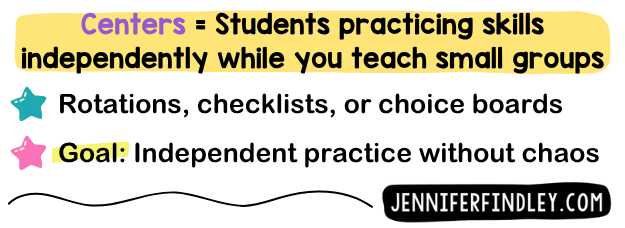
When I say “centers” or “stations,” I mean this:
- Students are working on different tasks while you meet with small groups.
- They may rotate or stay in one place with a checklist or choice board.
- The goal: They’re practicing key skills without your direct guidance so you can focus on small group instruction.
This doesn’t require fancy bins or an activity for every day of the week.
You can start simple (and stay simple) and still get powerful results.
The Real Fear: “I Can’t Trust Them to Work on Their Own”
When teachers say their students don’t have “independent skills,” here’s what they often mean:
- They don’t stay on task unless you’re standing over them.
- They rush through the work with minimal effort.
- They interrupt small groups constantly.
- They finish early and immediately go off-track.
- They don’t take the work seriously.
Sound familiar?
All of this is real. But it doesn’t mean centers are off the table.
It just means independence needs to be taught (just like reading or writing skills) with modeling, structure, and practice.
Independence Isn’t a Trait. It’s a Skill Set.
One of the biggest mindset shifts I made as a teacher was this:
Independence isn’t something students have or don’t have. It’s something we teach.
Once I truly accepted that, everything changed.
Instead of assuming “they can’t do this,” I focused on systems that helped them learn how to:
- Start work without constant reminders
- Stay on task without me hovering
- Hold themselves accountable for quality
- Solve problems without panicking or giving up
Here’s what helped the most 👇
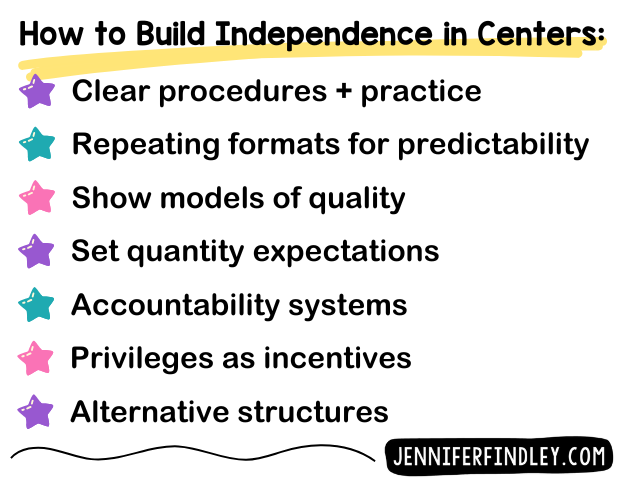
Strategy 1: Establish and Practice Clear Procedures
I taught center expectations the same way I taught reading skills:
- By modeling
- Showing examples and non-examples
- Giving students time to practice
- Reinforcing with visual anchors (like numbered expectation charts)
If students got off-task, I didn’t launch into a lecture. I just calmly said,
🗣️ “Check Expectation #3.”
Redirection became:
✅ Clear
✅ Calm
✅ Student-led
✅ Drama-free
Strategy 2: Use Repeating Formats for Predictability
You don’t need 10 new activities every week.
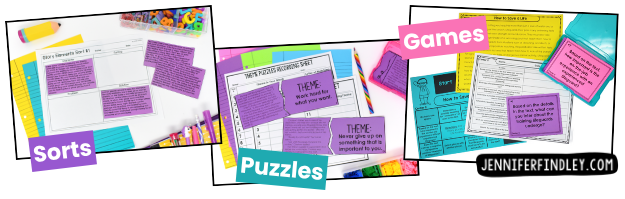
Instead, I used a consistent set of formats like:
- Reading puzzles
- Game boards
- Roll-and-respond activities
- Spinners and sorts
- Choice boards
The content rotated, but the structure stayed the same. Students always knew:
- Where to start
- What to do
- What “done” looked like
And I no longer had to reteach new systems every Monday.
Strategy 3: Show Them What Quality Work Looks Like
Sometimes students seem off-task…but really, they’re just rushing.
They think, If I get this done fast, I’m free!
To change that mindset, I built models of quality into every center.
Example:
In my Comparing Themes center, students read two short stories, sorted them by theme, and then wrote a response.
To support this, I included a student-friendly sample. We read it together and discussed what made it effective.
This helped students:
✅ Understand the expectation
✅ Take the work more seriously
✅ Stretch toward higher-quality responses
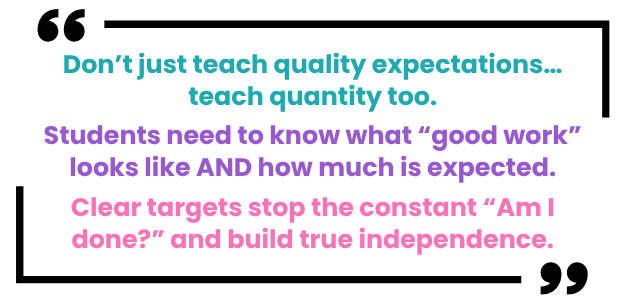
Strategy 4: Set Clear Expectations for Quantity Too
We often focus on quality, but clarity around quantity matters just as much.
I told students exactly how much they needed to complete, like:
- Match 5 puzzles and choose one to defend.
- Sort 6 texts and choose one to prove your sort.
- Answer all 8 questions.
- Finish 1 full round of a game and then choose 3 questions to answer on paper.
This eliminated the dreaded “Am I done?” question. They knew the expectation and could pace themselves accordingly (or at least start to learn to pace themselves).
Strategy 5: Build in Accountability Systems
Independence doesn’t mean lack of support. It means structured autonomy.
Here are some tools I used:
- ✅ Student checklists
- ✅ Quality checklists for written responses
- ✅ End-of-week reflections
- ✅ Spot-checks during centers with quick feedback or redirection
Sometimes I’d quietly glance at their checklist mid-center and just point to a skipped box. That quiet feedback? Powerful.
Strategy 6: Use Privileges as Incentives
My students loved certain centers:
- Partner reading
- Puzzle challenges
- Reading games
So we used them as built-in incentives. If students skipped steps or rushed through the work ➡️ they lost access to that center next time.
That only had to happen once. They realized quickly that focus and quality = more fun and more freedom.
Strategy 7: Try Alternative Structures That Still Build Independence
If full rotations feel like too much right now, don’t ditch centers altogether.
Just simplify the format.
Here are two easy alternatives:
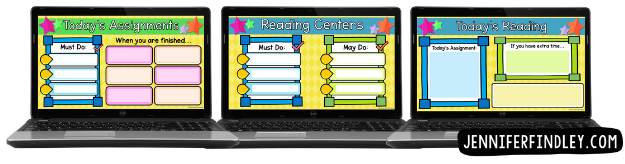
✔️ Must-Do/May-Do Checklists (No Rotation Needed)
- Students stay in their seats with a simple checklist.
- You pull small groups while they work independently at their own pace.
🔄 Whole Class Rotates Together
- Everyone does the same activity (like task cards or a reading game).
- After a set time, the whole class switches.
- Fewer moving parts. Same skill practice. Less chaos.
Both structures build independence while giving you space to teach in small groups.
Want Done-for-You Resources That Make This Easier?
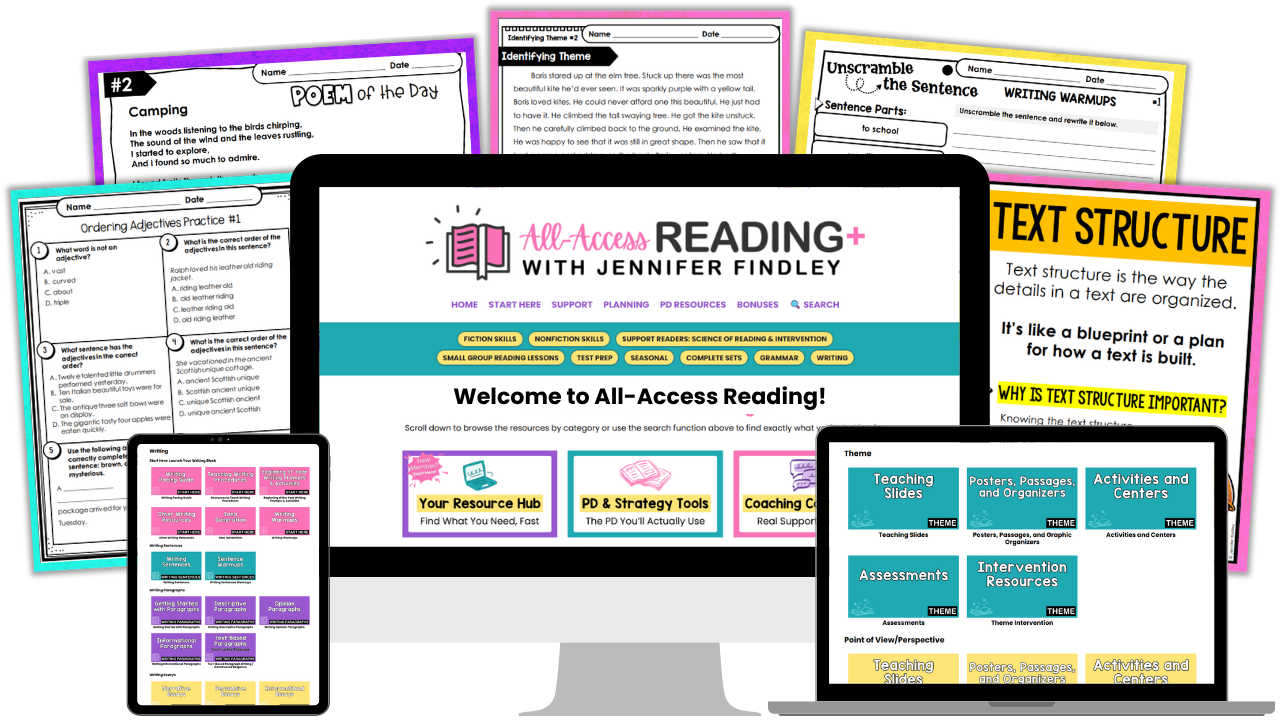
If you’re ready to try centers, but want to make sure you have the right resources, grab this free collection.
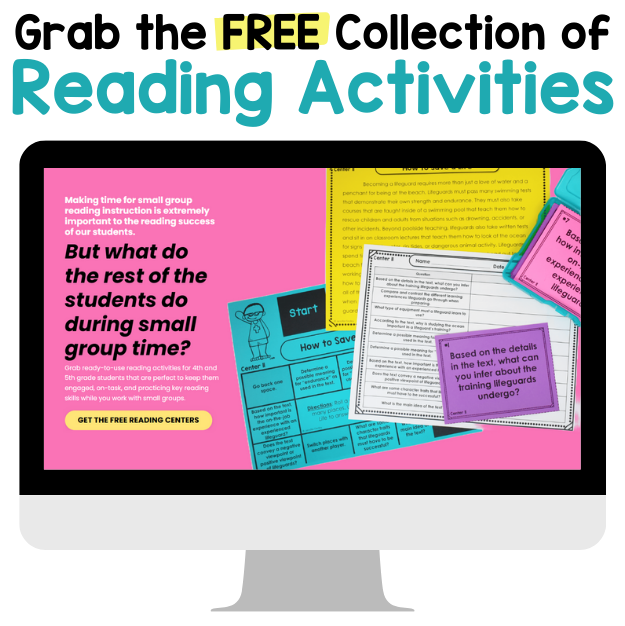
✅ My FREE Reading Activities Collection includes:
- 9 engaging, low-prep reading activities
- High-interest formats like puzzles, spinners, games, and sorts
- Student-friendly checklists and assignment slides
- Everything designed to build independence without overwhelm

Leave a Comment