

Small group reading is such a game-changer for 4th and 5th grade students.
But I know how easy it is to be unsure of what to do with your students or to not know if what you’re doing is actually working.
So I want to share what I believe is the best starting point for small group reading when you’re not sure what to focus on: morphology.
Morphology helps students improve word recognition by showing them patterns in multisyllabic words.Because it focuses on meaning, it also grows their vocabulary and gives them tools to unlock new words. It boosts engagement, supports fluency, and ultimately improves comprehension, too.
And the best part? It builds over time. You’re giving your students a structured path to grow as readers.
Let’s talk about how to make that happen.
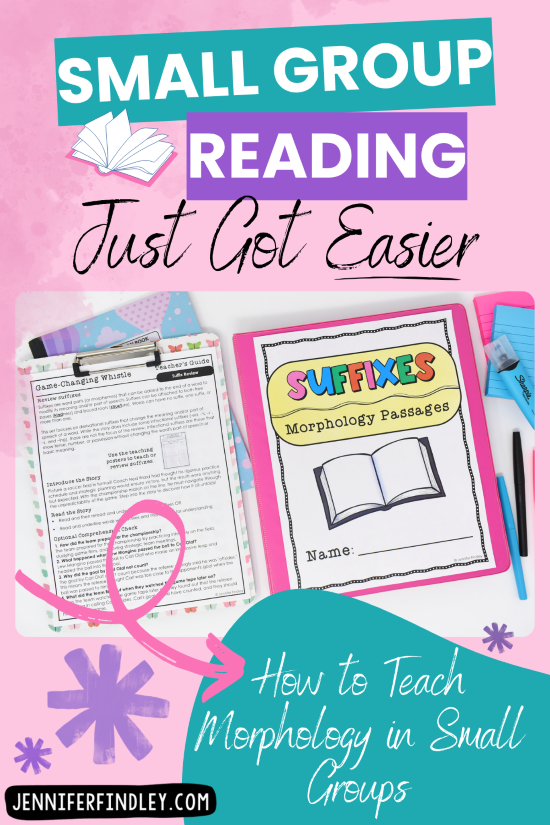
Step 1: Choose the Morpheme
Start by deciding which morpheme (prefix, suffix, or root) you want to focus on.
You can teach a single morpheme at a time or group a few together so students can compare and contrast. This saves time and builds deeper understanding.
Here are some ways to group morphemes meaningfully:
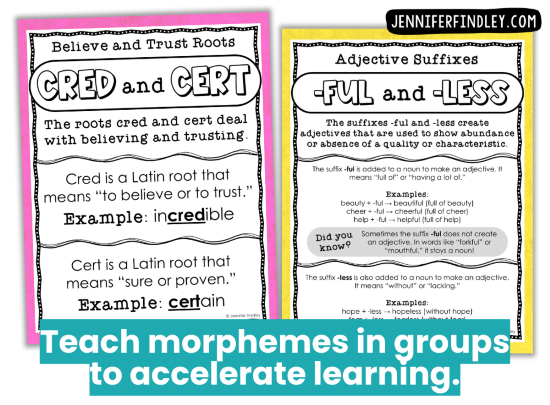
- Opposites: -ful vs. -less (helpful vs. helpless)
- Similar meanings: un- and dis- (not, opposite of)
- Part of speech patterns: -ion, -ness, -ment (nouns) or -ive, -ous, -y (adjectives)
- Thematic roots: vis/spect (look), aqua/hydr (water)
👉 Grouping by pattern or meaning helps students see how morphemes work together and helps you cover more ground.
You’ll teach or review the meaning later in Step 3. For now, all you need to do is choose the morpheme(s) that make the most sense for your group.
Step 2: Find or Create the Text
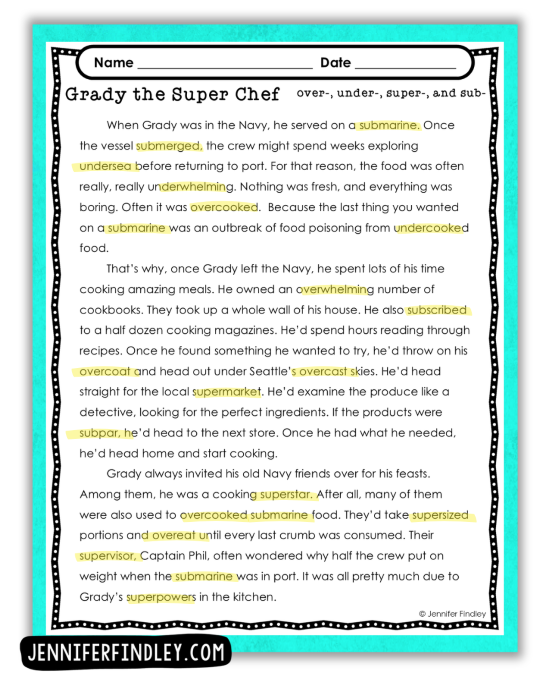
Your text is everything. A good morphology passage should be:
- Short and engaging so students can read it twice without losing focus
- Loaded with examples of your target morpheme(s)
- Natural in context (not contrived lists disguised as stories)
👉 Options:
- Find a text (sometimes a page from a novel, article, or decodable text works).
- Write your own (a short passage with multiple natural uses of the morpheme).
- Use a done-for-you passage (saves time, but not required).
Step 3: Review or Teach the Morpheme(s)
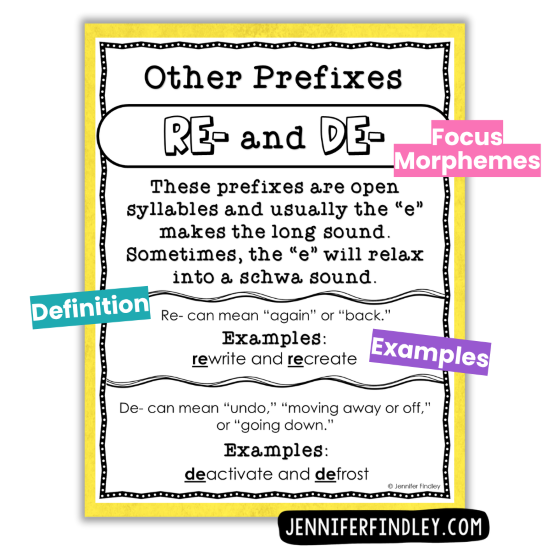
This step flexes depending on what your students need:
- If they already know the morpheme(s), keep it short as a review.
- If it’s their first time, spend a minute to teach the meaning clearly with an example or two.
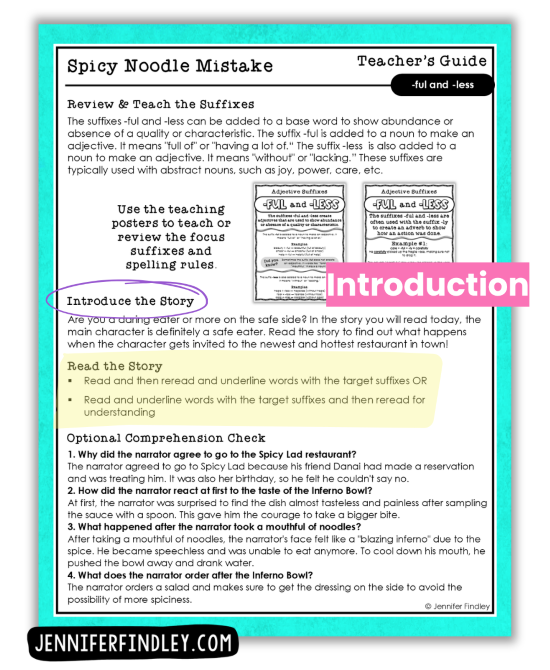
Step 4: Introduce the Story
Give students a quick preview of the story to set the purpose. Keep it short, just one or two sentences.
Examples:
- “This story is about a boy named Alex who migrates from his home village to chase big dreams.”
- “This story is about a boy who is a very picky eater. Let’s see what happens when he goes to a restaurant with some unusual food.”
Step 5: Tell How to Read the Story
Now explain the reading routine you want students to follow.
1. Read the story aloud once for enjoyment. Then reread and underline words with the target morphemes (prefix, suffix, or root) as you go.
👉 Choose this if your students need one uninterrupted read for comprehension first, before layering in word work.
2. Have students read the passage. As they read, stop to notice words with the focus affixes or roots. Reread sentences that contain them to check for meaning.
👉 Choose this if your students can handle noticing morphemes during the first read and you want to integrate comprehension and word work right away.
Reminder: Any time you do a second read, you’re also building fluency even if your main goal is morphology.
Step 6: Discuss the Words and the Story
This step has two parts, and you can flex based on your goals and the time you’ve got.
Part A: Comprehension Check (About the Story)
Keep students anchored in the passage by asking story-based questions.
- “Why did Alex want to migrate from his village?”
- “Why did Freddy talk to Kevin before the race?”
- “What happened when the narrator tried the Inferno Bowl?”
Part B: Morphology Word Work
Zoom in on morphology with tasks like:
- Asking questions that require students to discuss the target words or use them in responses
- Sorting words into categories by morpheme
- Having students write meanings using both context and morpheme knowledge
- Breaking apart words from the passage
- Generating new words with the same morpheme
- Writing sentences with target words or extending into new contexts
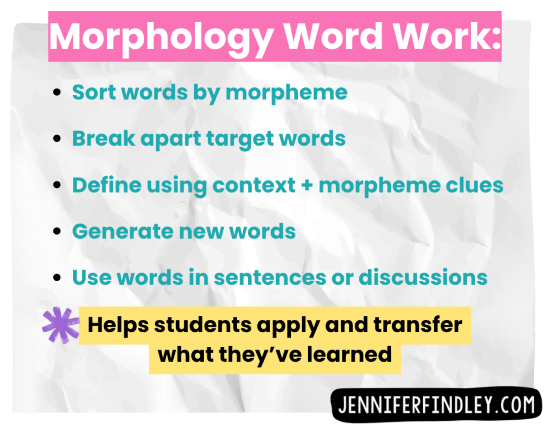
Morphology Word Work
- Sort words by morpheme
- Break apart target words
- Define using context + morpheme clues
- Generate new words
- Use words in sentences or discussions
👉 Helps students apply and transfer what they’ve learned
Step 7: Apply to New Words
Always close by stretching to words not in the passage.
- If single morpheme: give 2–3 fresh words (sluggish, reddish, childish)
- If grouped: give a short mix (joyful vs. joyless, redo vs. undo, visual vs. spectator)
This is where students prove they can transfer the pattern beyond the text.
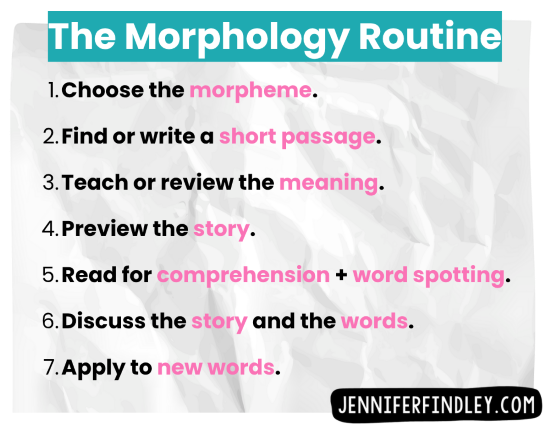
The Morphology Routine (Recap)
Here’s the full routine laid out so you can use it again and again and adapt it to fit your students and your time.
- Review the morpheme (prefix, suffix, or root word).
- Find or create a short text with multiple examples.
- Briefly teach or review the meaning.
- Preview the story so students know what they’re reading.
- Guide how to read it – one time read for comprehension, one for morpheme spotting.
- Discuss both the story and the words – comprehension and word work.
- Apply to new words to help transfer the learning.
Want Morphology Small Groups Done for You? Start Here.
By now, you’ve seen how powerful morphology can be when it’s taught with purpose and how this simple routine can give your small groups the structure they’ve been missing.
If you want a fully prepped system that follows this exact routine, check out my Morphology Small Group Lesson Bundles.
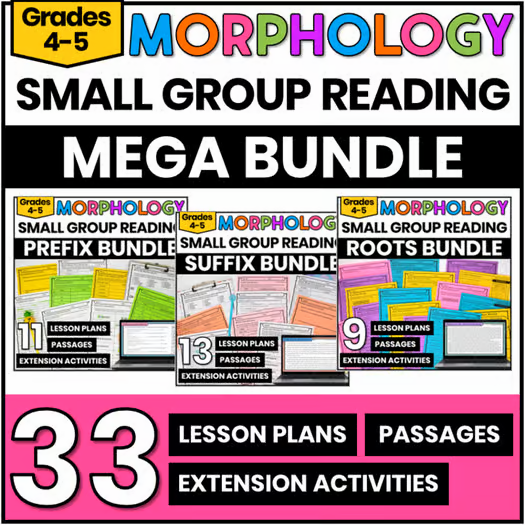
Each set is designed for prefixes, suffixes, or roots and includes:
- A quick teacher guide with morpheme background (including a breakdown of each target word) and a short intro to the story for student context
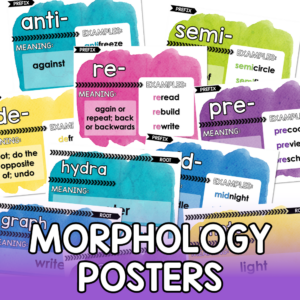
- A poster to teach the morphemes with clear definitions and examples
- An engaging, original passage filled with the morphemes
- Comprehension and extension activities you can mix and match
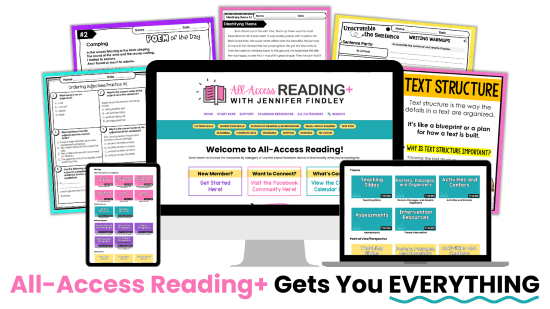
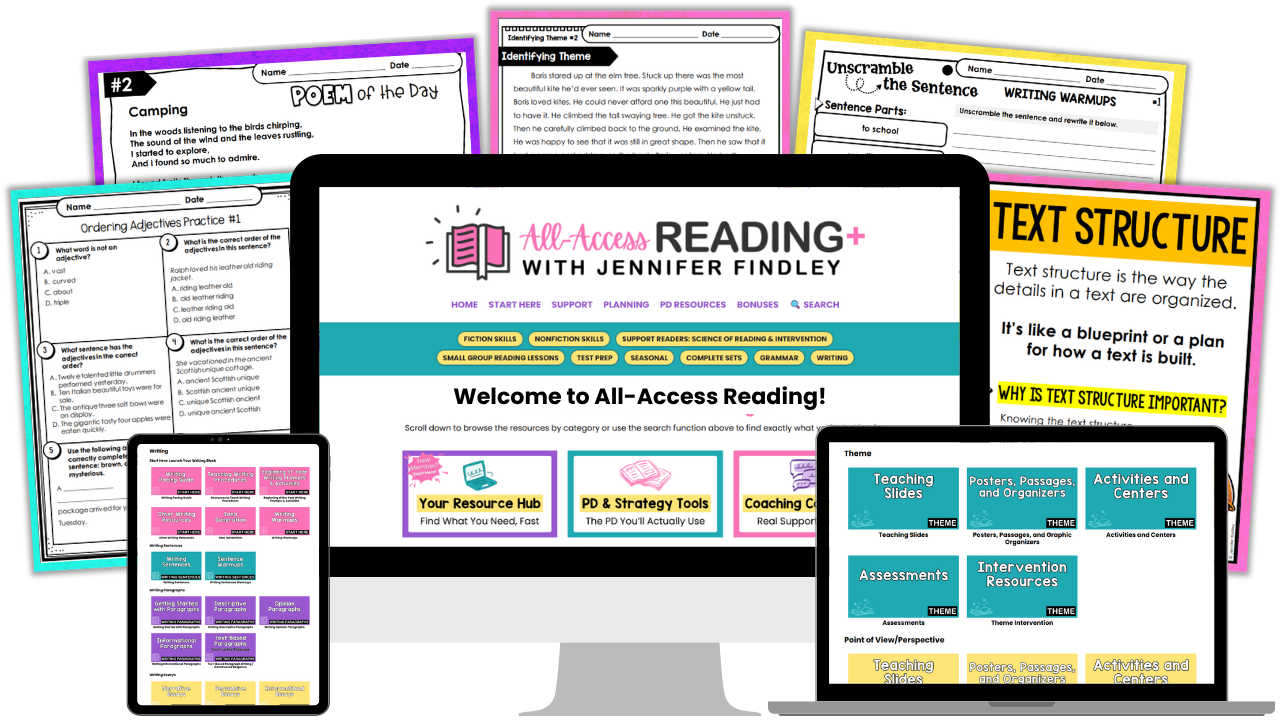
Already a member of All Access Reading+? These bundles are included in your membership inside the comprehensive Morphology Collection.
👉 Click here to access them directly.
👉 Check out the Morphology Small Group Bundles on TpT here.

Leave a Comment