

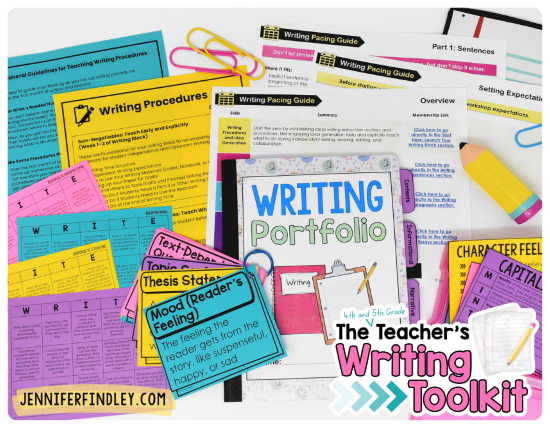
Looking for even more support on how to teach writing in 4th and 5th grade? Grab the writing toolkit that gives you resources to help you with pacing, procedures, and engagement for free.
If you’re like me (and honestly, like most educators) you probably weren’t really taught how to teach writing in college. We learned about reading instruction, maybe some grammar, but when it came to writing, most of us were thrown in and told, “Figure it out.” It’s no wonder that teaching writing feels challenging. When you add students who are already struggling to write, the challenge multiplies.
In this blog post, I want to share some different ways I have supported my writers through specific strategies and teaching moves. I’m going to divide this up into three categories:
- Students who struggle with planning
- Students who struggle with drafting
- Students who struggle with reviewing their writing (revising and editing)
Supporting Students with Planning
First, let’s talk about ways you can support your writers when they’re planning what to write.
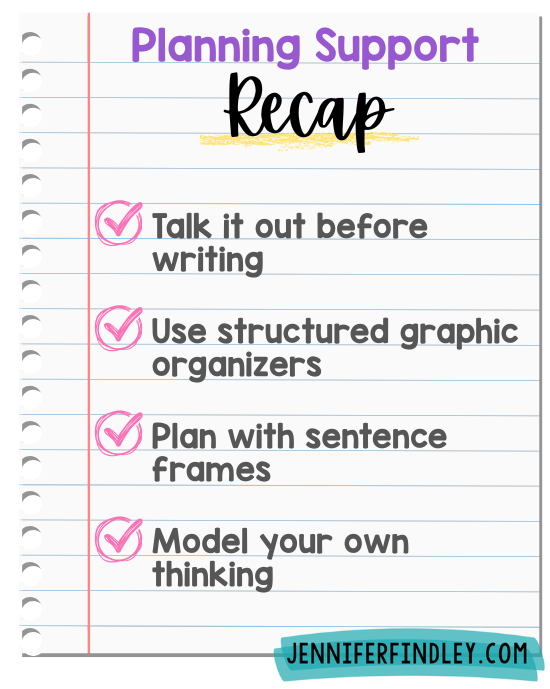
Oral Rehearsal: Whenever possible, have students talk first before they write. Talking gives students a chance to organize their thoughts, which makes it much easier to turn those ideas into sentences on paper. I always say, “If you can say it, you can write it.” If a student can’t put it into words, they’re probably going to struggle to write it down. Build in oral rehearsal often, even for single sentences. For example, before writing a topic sentence, have students turn and share it out loud with a partner.
Structured Graphic Organizers: Use graphic organizers that are highly structured and provide plenty of physical space for students to jot down ideas. Make sure the organizer fits the specific writing task, for instance, a story map for narratives or boxes and bullets for opinion writing. Go through the organizer together. Discuss each section, let students talk about their ideas, and then have them fill in the organizer. Explicitly teach different ways to record their thinking; I call this “caveman talk,” where students use simple words or phrases instead of full sentences (e.g., for a character trait: “Dogs: loyal, friendly, helpful”).
Sentence Frames for Planning: Alongside oral rehearsal and graphic organizers, give students sentence frames to scaffold their planning. For example, a frame like “In my opinion, students should…” helps students start talking and then record their thoughts in the organizer using that language. These notes using sentence frames can later become the foundation of their draft.
Model Your Thinking: Think aloud and model your own planning process for students. I take my class through an entire writing cycle together. We plan and write in small parts, share, revise, and edit as a group. During planning, I narrate my thinking step by step: how I choose ideas, break them into “caveman talk,” and organize them in the graphic organizer. This kind of modeling helps students see exactly what to do at each step.
Supporting Students with Drafting
Some students get stuck when it’s time to put ideas into sentences, even if they’ve planned well. Here are ways to support students during the drafting stage:
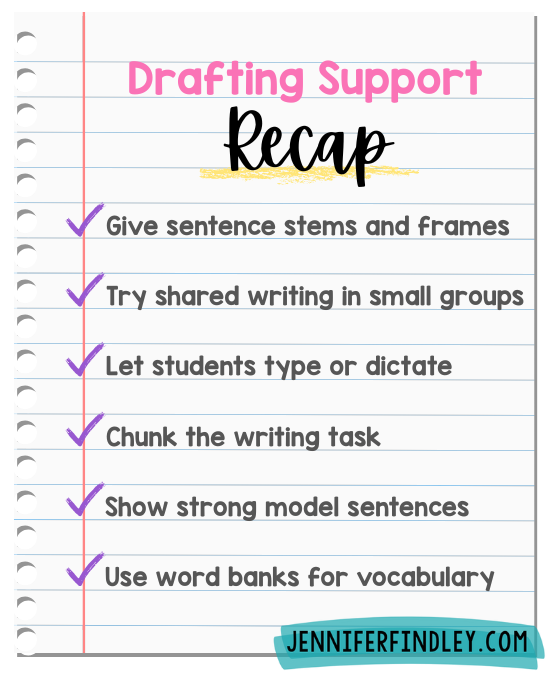
Sentence Stems and Paragraph Frames: Provide sentence stems (like “One reason is…” or “For example, …”) and paragraph frames (such as fill-in-the-blank templates for a whole paragraph). These structures help students get their ideas on the page when writing feels overwhelming. It might feel formulaic at first, but these supports build confidence. Students who don’t need the frames will naturally move away from them as they become more comfortable.
Shared Writing: Try shared writing, especially with small groups who need extra support. In shared writing, you and your students cowrite a piece together. You might model writing a sentence, then have students suggest the next one or talk through decisions as you build a paragraph. This helps students see how ideas and planning turn into full drafts.
Dictation and Typing: Allow students to dictate their writing to you, a peer, or a speech-to-text tool. You can also let students type their responses instead of writing by hand. This is especially helpful for students with fine motor challenges or handwriting fatigue, so the focus stays on their ideas instead of their penmanship.
Chunk the Writing: Break drafting into manageable chunks. Have students write one section at a time like maybe just the hook, then the introduction, then the first body paragraph. After each chunk, pause to share and check for understanding or give feedback. This makes the process less overwhelming and allows for more targeted support. Side note: Also teach them how to specifically refer back to their graphic organizer planning for each chunk they write.
Strong Models: Provide model sentences and paragraphs for students to reference. For example, show a sample introduction or a model body paragraph. Invite students to mimic the structure (For example, “Dogs make great pets because they are loyal and playful.”) and then try writing their own version using the same style. Models help students understand both structure and variety.
Word Banks: Give students word banks with content-specific vocabulary or transition words. You can provide these yourself, create them with your class, or build them from anchor charts used during lessons. Having words to choose from makes it easier for students to get started and use more precise language in their writing.
Supporting Students with Reviewing (Revising & Editing)
After students have planned and drafted their writing, many still need targeted support with rereading, revising for meaning, and editing for conventions. Here are practical ways to help:
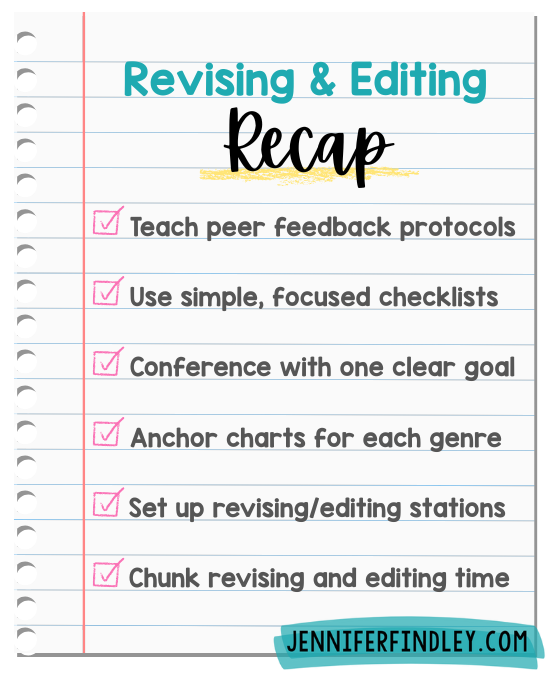
Peer and Partner Feedback: Explicitly teach students how to give focused, helpful feedback to a partner. Don’t assume students know what to look for. Without direct instruction, feedback usually sounds like “It’s good” or just points out punctuation. Give students a simple protocol, like “Two Stars and a Wish” (two things they like, one thing to improve) or “TAG” (Tell something you like, Ask a question, Give a suggestion). If you want them to focus on reasons in an opinion essay, give them a prompt: “Did your partner include at least two reasons to support their opinion?”
Checklists: Provide revising and editing checklists, but keep them short and focused. Aim for 3-5 items so students aren’t overwhelmed. Tailor the checklist to the writing task. For example, a persuasive writing checklist might include:
- Did you clearly state your opinion?
- Did you give at least two reasons?
- Did you include evidence or examples?
Editing-Focused Checklists: For students who struggle with basic conventions, use a checklist that targets just capitals and punctuation. Give them guided prompts such as, “Read a sentence: pop a period. Read a sentence: does it have a capital letter?” These can be used independently, in pairs, or during a quick teacher conference.
Teacher Conferencing: If you can, hold short conferences with students and focus on just one goal per session (like fixing run-on sentences or adding evidence). Don’t overload them; one clear target at a time helps students make real progress.
Anchor Charts: Use genre-specific anchor charts to remind students of revising and editing strategies. For example, display a chart with strong ways to open a narrative or one that lists transition words for opinion essays. Refer back to these during revision time.
Revising and Editing Stations: Set up classroom stations with specific directions and concrete examples at each one. For example:
- Capitals & Periods Station — Students check their drafts for correct sentence punctuation.
- Add Details Station — Students use a checklist to add at least one sensory detail or supporting fact to each paragraph.
- Strong Openings Station — Students rework their first sentence using the anchor chart.
Chunk the Revision: Break revising and editing into separate, manageable sessions. For example, spend five minutes just revising for ideas and details, then five minutes just editing for conventions. Setting a timer helps keep students focused on one task at a time, so nothing feels overwhelming.
Supporting writers in 4th and 5th grade isn’t easy, but it’s doable when you break the process down and meet students where they are. Whether your students are stuck at the planning stage, overwhelmed by drafting, or unsure how to revise and edit, targeted support makes a difference.
Want these supports ready to go?
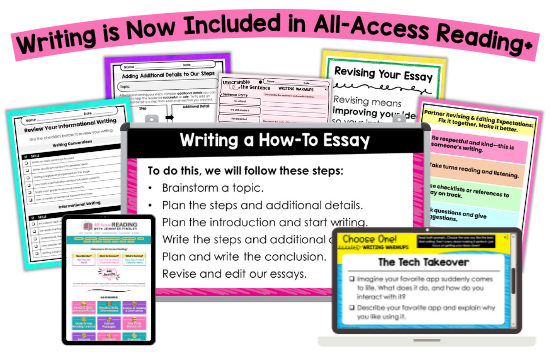
Inside the All Access Reading+ Membership, you’ll get:
- Teaching Slides with Model Texts that walk students through each phase of writing, with examples and built-in sentence frames.
- Paragraph Slides for focused, step-by-step instruction on single-paragraph writing.
- Writing Warmups to get students started, build stamina, and improve their writing across all three genres.
- Student Procedures like partner revision and turn-and-talk protocols, ready for you to teach.
- Idea-Generation Activities to help students find topics and get unstuck.
- Writing Centers with engaging, genre-based activities.
Plus, new resources are always being added, so you’ll have fresh support all year.
Ready to make writing instruction easier? Click here or on the image to join today!
Want more free writing support for your 4th and 5th graders?
If teaching writing in 4th and 5th grade is difficult for you, you’re not alone. It’s really that hard, and I’d love to continue supporting you. Get your hands on my free writing toolkit to help you with pacing, procedures, and engagement. Click here or on the image to access it now!

Leave a Comment