

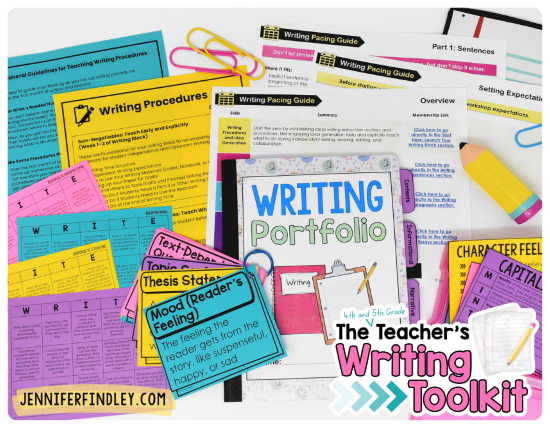
Looking for even more support on how to teach writing in 4th and 5th grade? Grab the writing toolkit that gives you resources to help you with pacing, procedures, and engagement for free.
If you’re here, you’ve probably felt this frustration: You teach paragraph structure. Your students practice.
You throw in anchor charts, routines, maybe even a “paragraph of the week.” But when you read their work? The ideas wander, sentences repeat, and the structure just doesn’t stick.
Sound familiar? Here’s the thing: It’s not you. It’s the traditional approach.
Why the Traditional Paragraph Instruction Falls Short
Most of us were taught paragraphs as a formula:
- Topic sentence
- Supporting sentences
- Closing sentence
Teach it, practice it, hope it clicks. But here’s the problem: Kids don’t just need to know what a paragraph is…they need to see how it works across different types of writing.
Without seeing the structure in action across genres (opinion, cause and effect, compare and contrast, etc.), students struggle to transfer those skills.

What Actually Works
Here’s the shift that changed everything in my classroom:
- Model the basics. Yes, start with the structure.
- Spiral it through genres/text structures. Keep revisiting the structure as you teach different types of paragraphs.
- Show how each part of a paragraph changes depending on the type of writing:
- A topic sentence in an opinion paragraph looks different than one in a descriptive or cause-and-effect paragraph.
- Supporting sentences might give reasons in one genre, details in another, or show relationships in another.
- Closing sentences should feel meaningful and specific to the genre, not just a reworded topic sentence.
When students see how paragraphs adapt to different purposes, they don’t just memorize, they understand.

The 7 Types of Paragraphs to Teach
If you’re wondering where to focus, these are the paragraph types that make the biggest impact for upper elementary writers:
- Descriptive: Brings an idea or setting to life.
- Opinion: States a claim and supports it with reasons.
- Compare & Contrast: Highlights similarities and differences.
- Problem & Solution: Explains a problem and how to solve it.
- Sequence/How-To: Orders steps or events clearly.
- Classification: Groups items or ideas by category.
- Cause & Effect: Explains why something happened and what resulted.
By spiraling the basics through each of these, students build a deep, transferable understanding of how paragraphs work.

Want Paragraph Writing That Finally Sticks?
If you’re ready to stop reteaching the same thing over and over, I’ve created a resource to make this process simple and effective.
Here’s what’s inside:
- Introductory slides to model paragraph structure
- Seven step-by-step teaching slide decks (one for each major paragraph type)
- A bonus set of differentiated prompts you can use all year
Everything you need to teach paragraph writing is in one place. Click here or on the image to grab the Done For You Paragraph Writing Bundle and finally make paragraph writing stick.

Want more free writing support for your 4th and 5th graders?
If teaching writing in 4th and 5th grade is difficult for you, you’re not alone. It’s really that hard, and I’d love to continue supporting you. Get your hands on my free writing toolkit to help you with pacing, procedures, and engagement. Click here or on the image to access it now!

Leave a Comment