

If you’ve ever told your students to “add more to your sentences” and ended up with a 37-word run-on, you already know why compound sentences matter. 🙃
Teaching kids how to join ideas the right way is the key to building stronger writing, avoiding endless fragments, and breaking the cycle of “just glue it all together with and.”
But here’s the part most people miss:
Understanding compound sentences can actually boost comprehension.
When kids recognize how conjunctions signal meaning (and = add, but = contrast, so = cause/effect), they’re not just pausing at commas. They’re connecting ideas the way the author intended.
In this post, I share:
- The grammar knowledge you need to teach this with confidence
- The exact strategies I used in my own classroom
- And a breakdown of why it matters, including that connection to comprehension

First Things First: Clauses
Let’s start with the foundation.
A clause is just a group of words with a subject and a predicate.
- Independent clause = can stand alone as a complete sentence.
→ The rain stopped suddenly. - Dependent clause = also has a subject and predicate, but it’s incomplete because of a trigger word. It’s waiting for more.
→ Because the rain stopped suddenly… (not a full sentence yet)
Those trigger words (like because, when, although, who, which, that) are what make the clause feel like it’s hanging and needs something else to make sense.
When we’re teaching compound sentences, we’re only working with independent clauses. The dependent ones come into play when we get into complex sentence territory.
So, What Is a Compound Sentence?
Now that we know we’re working with independent clauses only, let’s talk about what actually makes a compound sentence.
A compound sentence is two independent clauses joined together correctly.
In upper elementary, there are two main ways to do that:
1. With a coordinating conjunction (FANBOYS)
(for, and, nor, but, or, yet, so)
The bell rang, and sneakers pounded the floor toward the exit.
She didn’t study, nor did she bring a pencil.
I brought snacks, but I forgot the permission slips.
We could do the group project now, or we could procrastinate until Friday.
He practiced the speech for hours, yet he still called the principal “mom.”
The experiment exploded, so we opened a window..
These aren’t just longer sentences. They’re purposeful. Each conjunction tells the reader how the ideas connect:
- and = add
- but = contrast
- so = cause/effect
- or = choice
- nor = negative “choice”
- yet = unexpected twist
- for = fancy “because” that nobody uses unless they’re writing a formal letter to Narnia
2. With a semicolon
(This only works if the two ideas are closely related.)
The credits rolled; popcorn littered every seat and aisle.
The class ended; chaos immediately followed.
In this grade range, using semicolons is more of a stretch skill and not something every student needs to master right now.
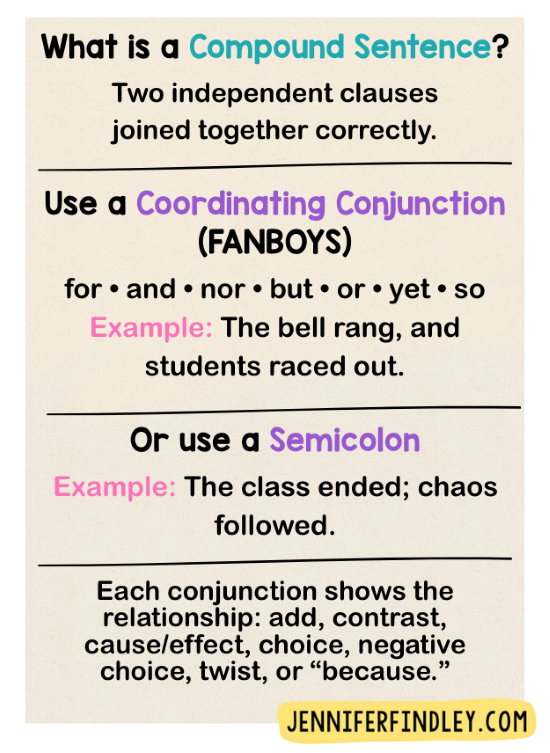
What’s a Compound Sentence?
Two independent clauses joined together correctly.
1. Use a coordinating conjunction (FANBOYS):
for • and • nor • but • or • yet • so
(Ex: The bell rang, and students raced out.)
2. Or use a semicolon:
(Ex: The class ended; chaos followed.)
Each conjunction shows the relationship: add, contrast, cause/effect, choice, negative choice, twist, or “because.”
Why Compound Sentences Matter
1. They Improve Comprehension
Compound sentences come with built-in signals for meaning.
When kids learn to spot a coordinating conjunction, they’re not just finding a comma break. They’re learning how the two ideas connect.
- Whales breathe air, and some can stay underwater longer than an hour. (and = adding)
- She liked the plan, but she wanted to know more before saying yes. (but = contrast)
- The goalie blocked the shot, so the crowd leapt to their feet. (so = cause/effect)
Here’s the problem:
If students are only trained to “look for the comma,” they may pause in the right place but still miss the why.
When we explicitly teach that and = adding, but = contrasting, so = cause/effect, or = choice, students start reading for logic, not just punctuation.
This does two impactful things for comprehension:
- Breaks down long sentences. A 20-word sentence stops feeling like one giant blur. They can chunk it into two smaller ideas.
- Connects the dots between ideas. Instead of reading them as random statements, kids actually understand the relationship the author intended.
That’s the magic of compound sentences: they’re not just longer, they’re purposeful.
2. They Strengthen Writing
Students who can write compound sentences have more moves in their writing playbook. They can:
- Compare and contrast
→ He wanted to play Roblox, but his sister opened her math assignment instead. - Show cause and effect
→ The cafeteria served pizza, so the line stretched all the way to the door. - Add emphasis or drama
→ I stared at the clock, and finally the bell rang. - Shift the rhythm for variety
Without compounds: The volcano erupted. Lava flowed down the mountain. Ash filled the air. (choppy, robotic)
With compounds: The volcano erupted, and lava flowed down the mountain. Ash filled the air.
Once kids see how but changes meaning compared to and or so, they stop stringing thoughts together randomly. Instead, they start making purposeful choices about how their writing sounds and flows.

Best Practices for Teaching Compound Sentences
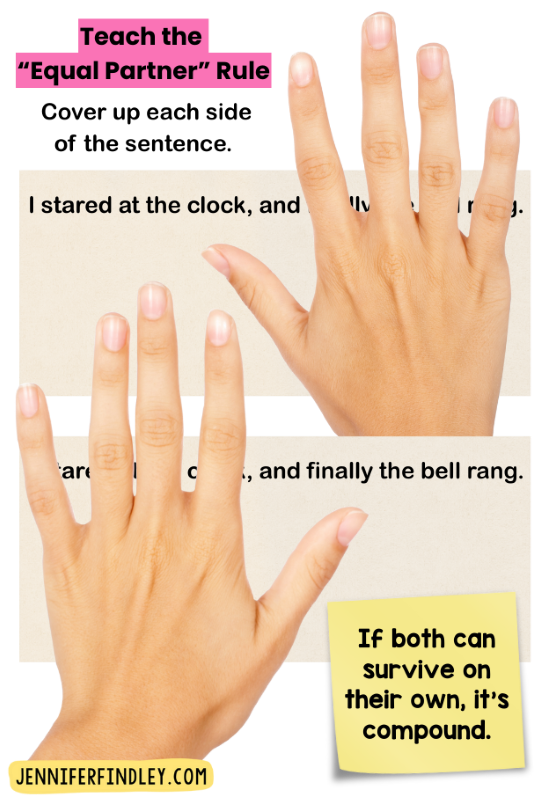
1. Teach the “Equal Partner” Rule
Say it out loud:
A compound sentence is two independent clauses joined correctly.
Have students test it by covering each side of the sentence.
If both can survive on their own, it’s compound. If not, you’ve crossed into complex territory.
2. Teach FANBOYS by Function, Not Just Acronym
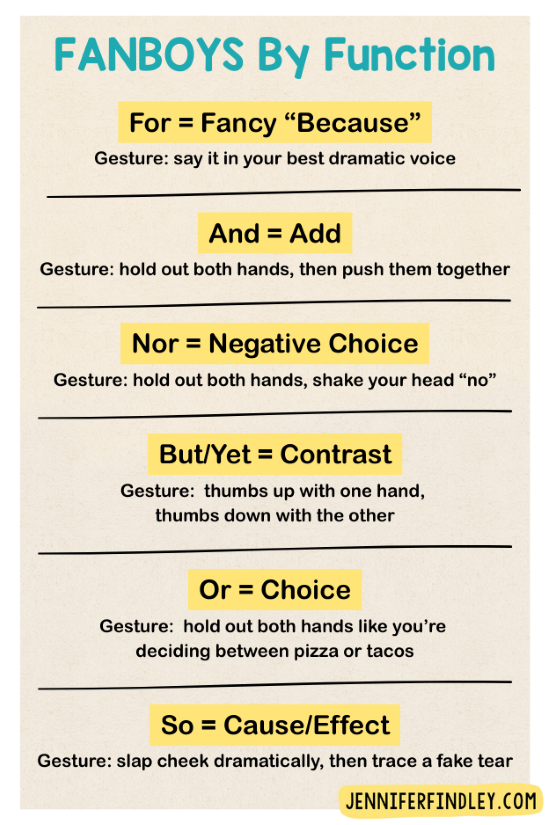
Chanting “for, and, nor, but, or, yet, so” only gets kids so far. The real power comes when they know the job of each one.
- So = cause/effect (gesture: slap cheek dramatically, then trace a fake tear)
- And = add (gesture: hold out both hands, then push them together)
- Nor = negative choice (gesture: hold out both hands, shake your head “no”)
- But/Yet = contrast (gesture: thumbs up with one hand, thumbs down with the other)
- Or = choice (gesture: hold out both hands like you’re deciding between pizza or tacos)
- For = fancy “because” (gesture: say it in your best dramatic voice)
When kids act it out, the meaning sticks and they start choosing conjunctions that actually fit their ideas, instead of defaulting to “and” every time.
3. Use Sentence Combining as Practice
Give students two short sentences and ask them to join them:
- It started to rain. We went inside.
Possible combinations:
- It started to rain, so we went inside.
- It started to rain, but we stayed outside.
Now discuss how the meaning shifts depending on the conjunction.
(This is where the lightbulbs go off. 💡)
4. Connect to Reading
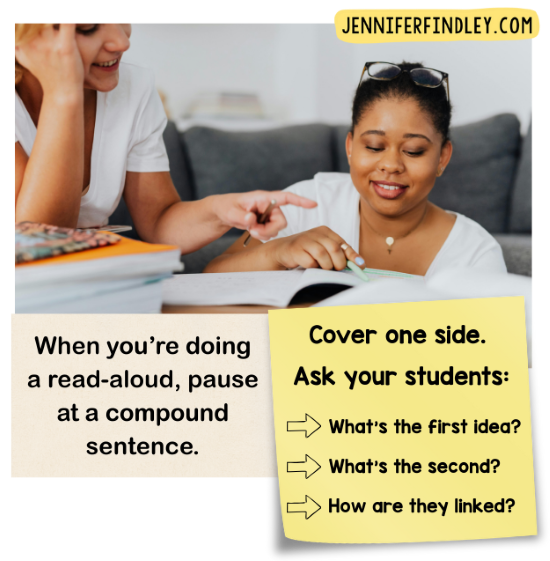
When you’re doing a read-aloud, pause at a compound sentence.
Cover one side. Ask your students:
- What’s the first idea?
- What’s the second?
- How are they linked?
This makes the grammar skill show up in real books instead of just worksheets.
5. Keep Run-Ons in Check
Show kids how misusing commas creates “run-on mush.” (Yes, you can call it mush. They’ll remember. 😅)
Teach them two easy fixes:
- Add a coordinating conjunction with a comma.
- Make two separate sentences.
I personally avoid semi-colons like the plague, but it’s an option for a fix too.
Want Ready-to-Use Resources?
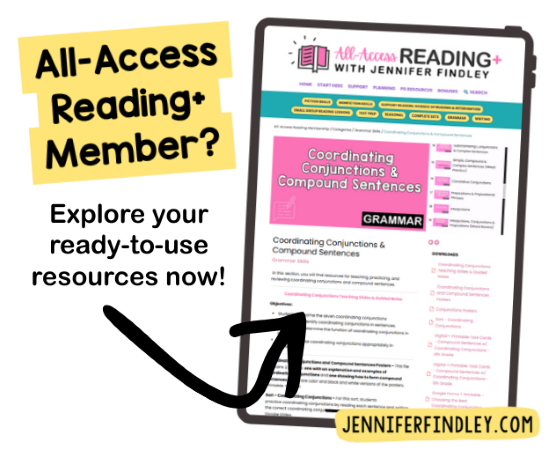
If you’re a member of All Access Reading+, you’ll find an entire section on coordinating conjunctions and compound sentences, complete with interactive slides, guided notes, posters, practice sets, task cards, and even games like Spoons.
Everything is ready to use, so you can spend less time planning and more time teaching.
👉 Click here to explore your resources.
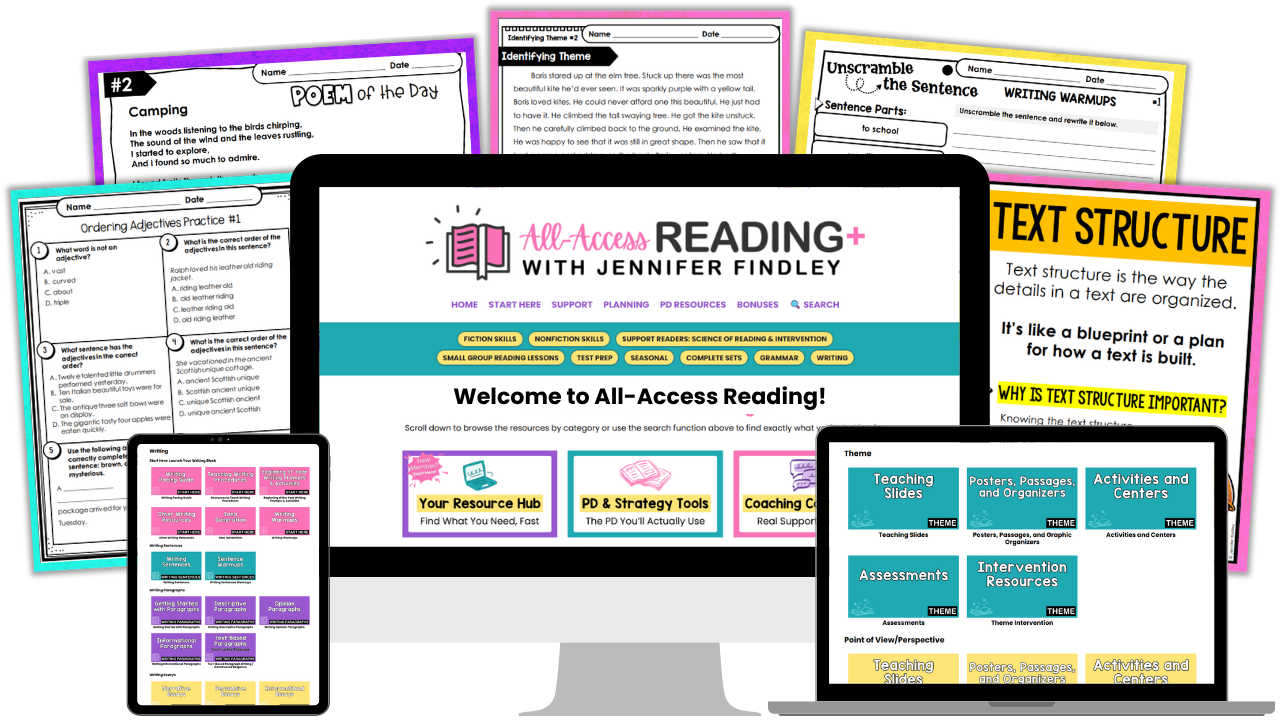
Not a member yet? We’d love to have you! Click below to learn more and join today.



Leave a Comment