

If you’re not sure how to teach text structure (or the way you’re teaching it isn’t landing), this breakdown is for you.
Text structure is one of those tricky skills that can feel straightforward but often doesn’t click for students the way we hope.
They might rely too heavily on clue words.
Or confuse structure with main idea.
Or simply not see why it matters.
Most of the time, students are only taught to “look for keywords” and not to understand how authors build meaning.
In this post, I’ll share exactly how I taught text structure to 4th and 5th graders in a way that helped them move past keyword hunting and start seeing how texts are intentionally built to communicate ideas.

Step 1: Introduce the Concept Before the Labels
Before I ever introduced the five core types of text structure, I started with the bigger picture.
I helped students understand that text structure is the way an author organizes ideas to support their main idea or point.
Once an author knows what they want to say, they decide how to connect those ideas and that’s structure.
🍕 How I Introduced It
To make this real for students, I used the topic pizza and gave them short texts written using different structures:
- One described pizza
- One gave the steps to make it
- One compared pizza to another food
- One explained the effects of eating too much
- One introduced a problem related to school lunch and suggested pizza as the solution
Same topic, different structures.
We read and discussed each one, looking at:
- How the details were presented differently
- How the organization changed based on the author’s purpose
- How the structure supported what the author wanted us to understand
Doing this showed students that structure isn’t just a label. It’s a way of building the message. When the topic stays the same, the shift in structure is even more visible.
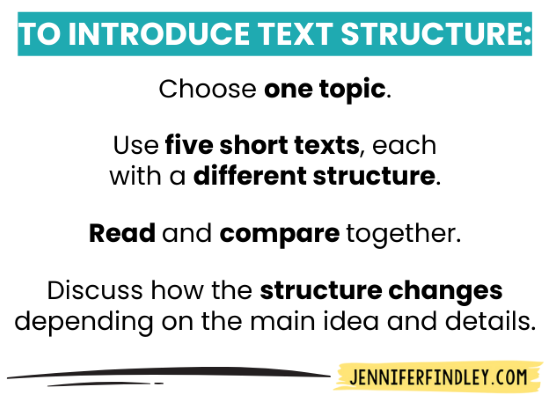
Choose one topic (I used pizza)
Use five short texts, each with a different structure
Read and compare together
Discuss how the structure changes depending on the main idea + details
Step 2: Deep Dive into Each Structure
Once students had the concept, we zoomed in on one structure at a time.
Depending on the time frame, I’d do either:
- One structure per day
- Or two structures per day (with clear boundaries)
Either way, each lesson had the same flow:
1. Read and Analyze a Strong Mentor Text
We used passages that clearly modeled a single structure. Students read them with one question in mind: How did the author build this?
We would:
- Highlight sentences that revealed the structure (e.g. comparisons, effects, problems)
- Discuss organizational patterns within the structure (especially for compare/contrast or problem/solution)
- Talk about how the structure supported the purpose
The goal here was comprehension through structure, not just spotting clue or signal words.
2. Structurally Map the Text
Next, we used a graphic organizer to map the structure using “caveman talk,” which is just simple phrases that capture the ideas without full sentences.
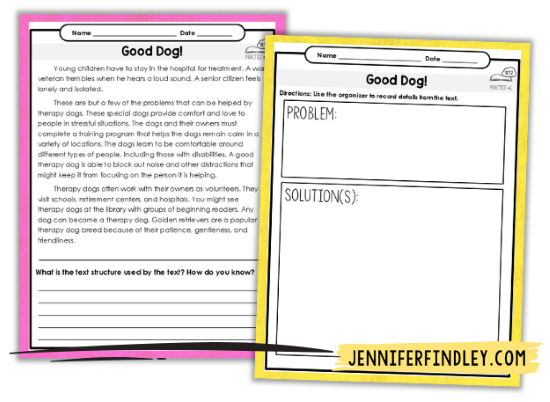
3. Practice Writing (or Speaking) in the Structure
If time allowed, we extended the lesson into writing to strengthen their understanding of structure.
Some examples that you can easily slide into your text structure lessons:

| Structure | Prompt Example |
| Description | Describe your favorite food |
| Sequence | What do you do when you get to school? |
| Compare and Contrast | Recess now vs. kindergarten |
| Cause and Effect | What happens when it rains? |
| Problem and Solution | Forgot your homework. Fix it. |
If writing wasn’t feasible because of time, we did it as a quick oral rehearsal. Students would talk through the structure, using sentence frames or their own words.
📝 A Note on Signal Words
Yes, we discussed signal words but only in the context of structure and meaning.
I taught students:
- These words are clues, not answers.
- They help connect ideas.
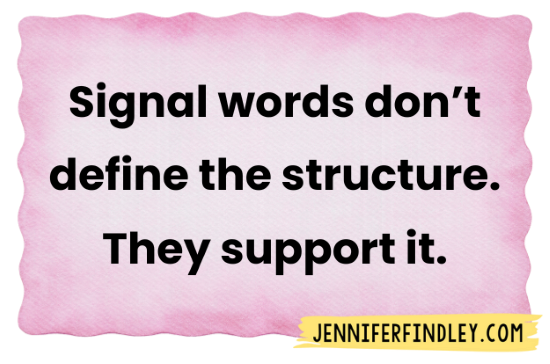
- They support structure, but don’t define it.
Instead of telling students to “look for because or however,” we asked:
Why did the author use this word here?
What idea is it helping to connect?
How does it support the structure of the paragraph?
Step 3: Explore Texts with Multiple Structures
Once students understood the five types, we moved into real texts that used more than one structure. (Note: Most 4th grade teachers are not required to get to this step in their instruction.)
We read multi-paragraph passages and traced the shifts in structure.
A typical example:
- Starts with a description of a problem
- Moves into cause and effect to explain how it got worse
- Ends with a problem/solution paragraph to suggest fixes
Each time, we asked:
✔️ Where did the structure shift?
✔️ Why did the author organize it this way?
✔️ What did it help us understand?
This step helped students stop expecting one answer and start seeing structure as a flexible tool that authors use with intention.
Recap: The Teaching Flow That Worked
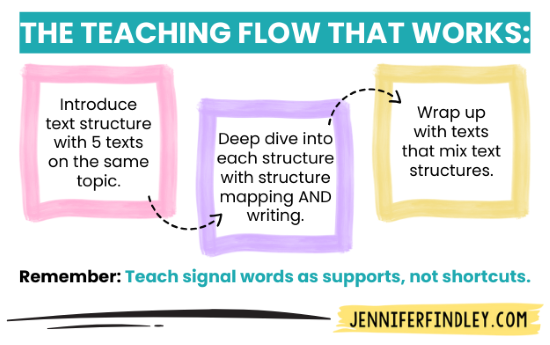
- Introduce text structure with 5 texts on the same topic.
- Deep dive into each structure with structure mapping AND writing.
- Wrap up with texts that mix text structures.



Leave a Comment