

Theme is one of the trickiest skills for upper elementary students…and honestly, it surprised me how hard it was the first time I taught it.
When our standards shifted to Common Core, I was excited. I love reading fiction, and I thought teaching theme would be a natural fit.
However, in practice, my students struggled. Looking back now, it makes sense: theme requires higher-level comprehension. If students are not steady with literal or inferential comprehension, theme becomes even tougher.
Because so many of my students had shaky comprehension, my theme instruction had to be really intentional. I couldn’t just throw the word “theme” at them and expect it to click. I needed a clear structure to help them build up to it.
For me, that structure came down to three main parts:
- Build an understanding of what theme actually is.
- Teach strategies that help students uncover the theme when it is not stated.
- Show students how to prove the theme with text evidence.

Step 1: Build a Strong Foundation for Theme
Before students can identify or write a theme, they need a clear idea of what theme actually means. If that foundation is not there, the strategies later on will fall flat.
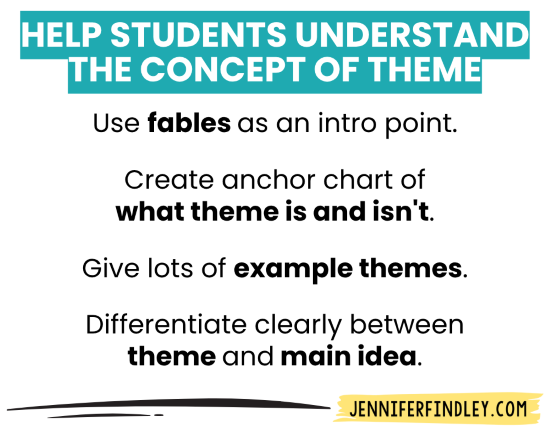
Use Fables as a Safe Entry Point
I often started with fables that included a printed moral. We would read the story, talk about the moral, and discuss how the story showed it. Sometimes I would cover up the moral and have students try to guess it.
Because morals are usually pretty obvious, they gave students a safe entry point.
From here, I explained that a moral is a type of theme, but it is handed to you and framed as a very specific behavior lesson. For example, do not lie or treat others the way you want to be treated.
A theme in other stories will not usually be handed to you this way, and it often goes beyond a simple rule. That is why we need strategies to figure it out.
Anchor Charts: What Theme Is (and What It Is Not)
Next, I created anchor charts that defined theme and clarified what it was and what it was not. We also compared it to summaries and main ideas so students did not confuse the two.
When building the chart, I made sure to expose students to a wide variety of example themes. Many students did not know what kinds of lessons could count as themes, so we built a list together.
Along with the basic ones like honesty is the best policy or teamwork is important, we added less obvious ones such as:
- When you make a mistake, it is important to make it right.
- Having a plan B can help when something important does not go as expected.
- Plans built on dishonesty eventually fall apart.
This variety gave students a toolkit of possible themes they could pull from when reading more complex stories.
Theme vs. Main Idea (What Happened in the Story) Sorts
If students were still unsure of the difference between theme and main idea/summary, I brought out Theme vs. Main Idea sorts. These activities let them practice pairing short main idea summaries with possible themes and seeing the difference side by side.
It also gave them another chance to see how stories can be retold one way and summed up as a bigger life lesson another way.
Important Note: The goal in this stage was not just to define theme. It was to help students see the range of possible themes. That way, they were not stuck only generating the basics like be nice or do not lie.
Step 2: Teach Strategies to Identify Theme
Once my students had a solid understanding of what theme is, it was time to give them strategies to actually pull it out of stories.
Over the years, I have rotated between different strategies. Some years I have taught all three, and other years I have stuck with just one. It really depended on the group of students and the kinds of texts we were reading.
Having a few options in your back pocket makes it easier to give students a way in, no matter how the story is set up or how the theme is revealed.
Strategy 1: Focus on How the Character Responded
This was my favorite starting point because it was the most concrete.
How I taught it:
- What challenge did the character face?
- How did the character respond?
- What does that response show us about life?
Think-aloud example: “In this story, the character wanted to win the race, but when she tripped, she decided to get back up and finish anyway. Her response shows us something bigger: sometimes you do not win, but determination helps you finish what you started. That is a theme.”
Why this strategy works: Looking at the character’s challenge and response gave students an anchor in the text. Retelling or discussing those moments helped them understand the story better, without feeling like they had to analyze the whole thing at once. And once they could see what the character did and why, it was a natural step to ask, What does that show us about life?

💡 Example: She tripped but finished the race → Determination helps you finish what you start.
Strategy 2: Give the Character Advice
This strategy worked especially well when a character did not change or when students struggled to see growth.
How I taught it:
- Based on their struggle, what advice would you give this character?
- Could that advice also be true in real life? How could we phrase it as a lesson about life?
Think-aloud example: “This character kept lying to avoid getting into trouble. If I could give her advice, I would say: ‘Tell the truth, even if it is hard.’ That advice also works for real life, so a theme could be: honesty may be difficult, but it builds trust in the long run.”
Why this strategy works: Students love giving advice. It feels personal and easy for them. And the best part? Their advice almost always pointed to a bigger truth. By reframing that advice as a life lesson, students were basically uncovering the theme without even realizing it.
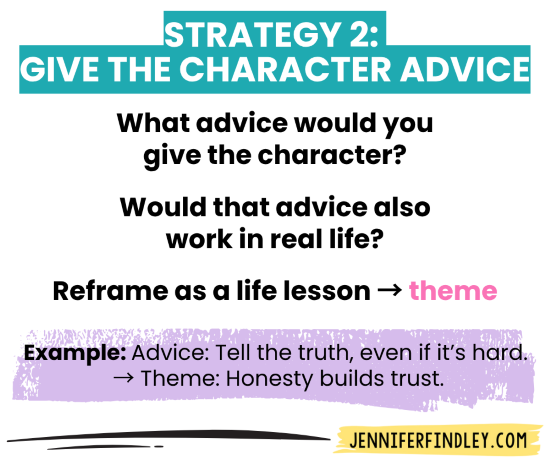
💡 Example: Advice: Tell the truth, even if it’s hard → Theme: Honesty builds trust.
Strategy 3: Focus on What the Character Learned
This was the most advanced strategy, but it often produced the best themes.
How I taught it:
- What did the character learn by the end of the story?
- How does that lesson point to a bigger truth about life?
Think-aloud example: “By the end, the boy learned that chasing popularity left him lonely. That points to a bigger theme: valuing true friendship is more important than seeking attention.”
Why this strategy works: Focusing on what the character learned pushed students to notice the turning point or the moment when the character’s thinking shifted in the story. Talking or writing about the lesson deepened their comprehension, but it also gave them the clearest path to theme. Once they could name what the character learned, it was an easy step to phrase it as a lesson that applied beyond the story.
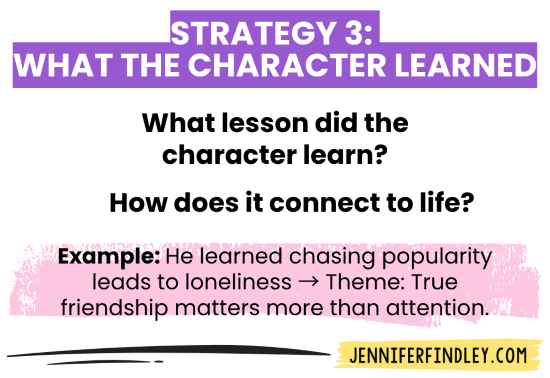
💡 Example: He learned chasing popularity leads to loneliness → Theme: True friendship matters more than attention.
Step 3: Prove the Theme With Text Evidence
Once my students really had a strong understanding of what theme is, and they could identify it in a story, the next step was showing them how to prove the theme or how the author developed it.
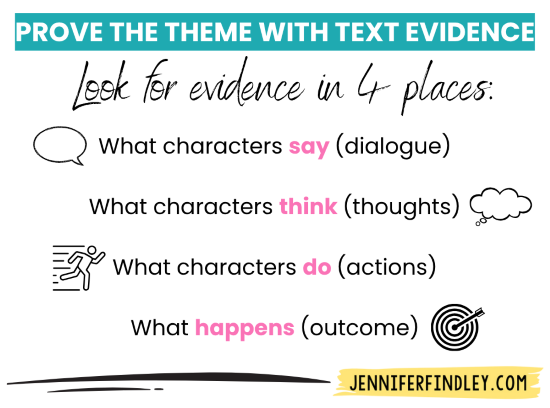
I kept it really simple. We looked for evidence of the theme in four places:
- What the characters say (dialogue)
- What the characters think (thoughts)
- What the characters do (actions)
- What happens as a result (the outcome)
We went back to these four every single time. It gave my students an easy checklist and kept it concrete.
How I Taught It
In Step 2, when students were just starting to identify themes, I had them anchor their answers with something simple like:
- “I think this is the theme because in the story ___.”
- “I know this is the theme because ___.”
Once they were ready, I pushed further. I taught them to find at least two pieces of evidence from those four places. We practiced putting it into a short, structured response, like this:
- “The theme of the story is ___.”
- “One piece of evidence is when the character says ___, which shows ___.”
- “Another piece of evidence is what happens at the end. When ___ happens, it shows ___.”
This step set my students up for success on written responses because they were not just naming a theme; they were proving it with text evidence.
Final Thoughts: Building Theme Step by Step
Step 1: Make the concept concrete.
- Start with fables that print the moral.
- Build the anchor chart for what theme is and is not.
- Create a wide theme bank.
- Run theme vs. main idea sorts so students can see the difference.
Step 2: Teach one strategy at a time.
- Character Response → Advice → Lesson Learned
- Talk first, then write. Use sentence stems.
Step 3: Support the theme with text evidence.
- Look in four places: what characters say, think, and do, and what happens.
- Require at least two pieces of evidence.
- Use the frames: “The theme is __.” “One piece of evidence is __, which shows __.” “Another piece is __, which shows __.”
Download a Bank of Example Themes
Get started with a reference sheet of example themes. The bank is full of themes organized by category and sorted by complexity. This allows you to move from simple to complex so you can build up to deeper thinking.




Leave a Comment