

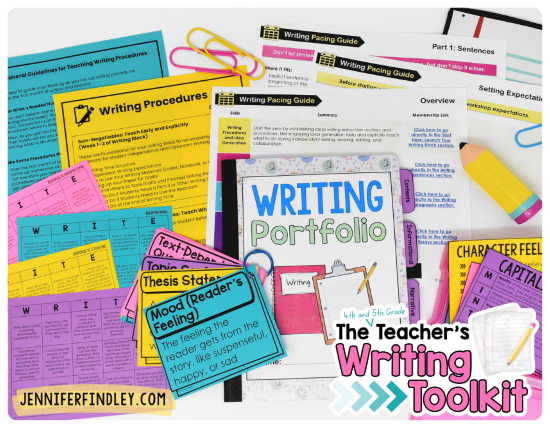
Looking for even more support on how to teach writing in 4th and 5th grade? Grab the writing toolkit that gives you resources to help you with pacing, procedures, and engagement for free.
Whether it was mentioned in a training, a book club, or a viral teacher thread, you may have already heard of The Writing Revolution. The main idea? We can’t really improve our students’ paragraphs or essays unless we start at the sentence level and build from there.
But if you’re a 4th or 5th grade teacher, you may be thinking, “That’s great and all (and it definitely makes sense), but my standards include essays.”
So yes, sentence-level writing matters, and you’re on board with that. But how do you work on sentences and paragraphs and essays…all at the same time?In this post, I want to share a few ideas for how you can actually make that happen. You can take them, tweak them, or just let them spark your own thinking. The goal is to help you find a way to balance all the pieces—sentence work, paragraph structure, full essays—in a way that helps your students grow as writers while still meeting your standards.
Start with Sentence-Level Instruction
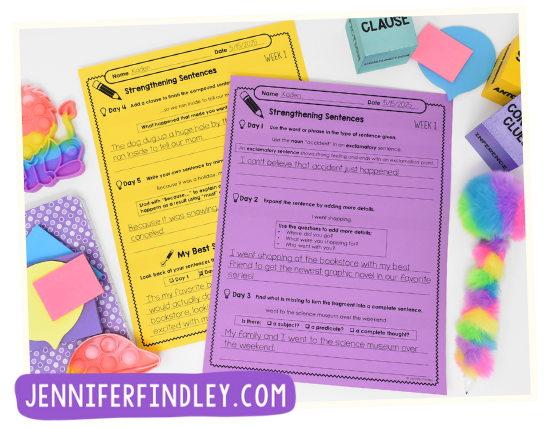
Early in the year, carve out time to directly teach sentence-level skills. This includes correcting fragments, expanding, and combining.
Try activities like:
- Fragment correction
- Sentence unscrambling
- Sentence expansion
- Because, But, So expansion
- Mimicking strong sentence models
- Combining sentences with purpose
After 2-3 weeks of explicit instruction, continue the sentence-level instruction and practice in one or more of these ways:
- Incorporate daily/weekly warm-ups (e.g., sentence combining, Because, But, So expansion, or mimic the sentence)
- Have students revise one paragraph for sentence variety, clarity, or structure OR even one sentence inside a paragraph during revision
- Use writing mini-lessons that target a sentence pattern or error you’re seeing in student drafts
- Implement genre-specific modeling, such as writing strong leads, transitions, or elaboration using sentence-level models
Integrating Sentence Writing Across Content Areas
Here are some of my favorite ways to integrate sentence writing practice (paired with explicit feedback and support) across subject areas.
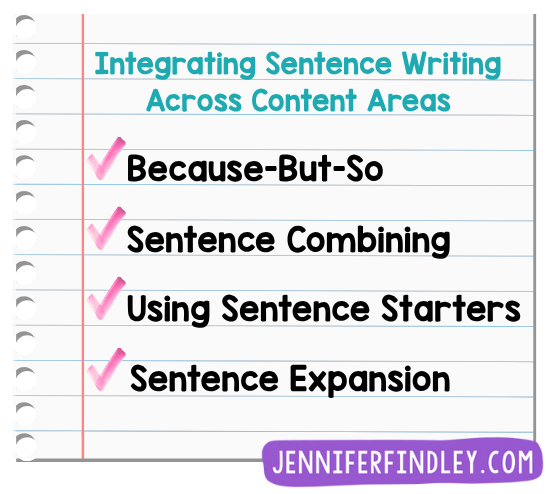
Because, But, So
- Use this structure to prompt reasoning, contrast, and elaboration.
Science:
- “Evaporation is important because…”
- “The animal blends in, but…”
- “Plants grow toward light, so…”
Social Studies:
- “The colonists protested because…”
- “The law was passed, but…”
- “The movement spread quickly, so…”
Math (Because Usually Works Best With Math):
- “I added first because…”
- “The answer seems right, but…”
- “We multiplied the sides, so…”
Sentence Combining
Science:
- “The sun gives off light. It warms the Earth.” → Combine using “which” or “because.”
Social Studies:
- “George Washington was the first president. He served two terms.” → Combine with a coordinating conjunction.
Math:
- “The shape has four sides. All sides are equal.” → Combine into a descriptive sentence.
Writing Strong Sentences Using Starters
Science:
- “Photosynthesis is…” → “Photosynthesis is the process by which…”
Social Studies:
- “A constitution is…” → “A constitution is a document that…”
Math:
- “The equation shows…” → “The equation shows the relationship between…”
Sentence Expansion
Science:
Base sentence:
- “The plant grew taller.”
Expanded versions:
- “The plant in the window grew taller.” (Where?)
- “The plant in the window grew taller over three weeks.” (When?)
- “The plant in the window grew taller over three weeks because it received water and sunlight daily.” (Why?)
- “The plant in the window grew taller over three weeks because it received water, sunlight, and nutrients from the soil daily.” (Where? When? Why? How often?)
Social Studies:
Base sentence:
- “The colonists protested.”
Expanded versions:
- “The colonists protested in Boston.” (Where?)
- “The colonists protested in Boston during the 1770s.” (When?)
- “The colonists protested in Boston during the 1770s because they were angry about British taxes.” (Why?)
- “The colonists in Boston protested during the 1770s because they were angry about British taxes like the Stamp Act and the Tea Act.” (Where? When? Why? What?)
Layer in Paragraph Instruction at the Right Time
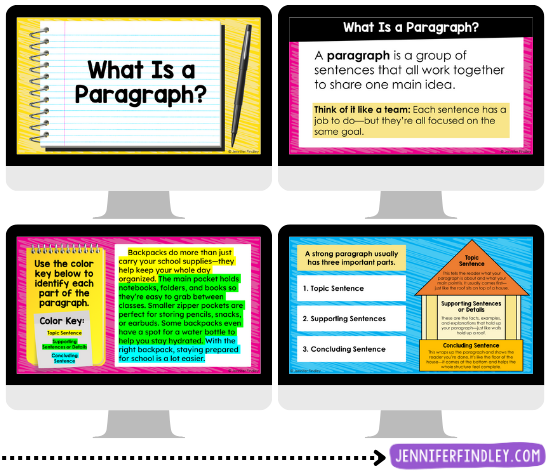
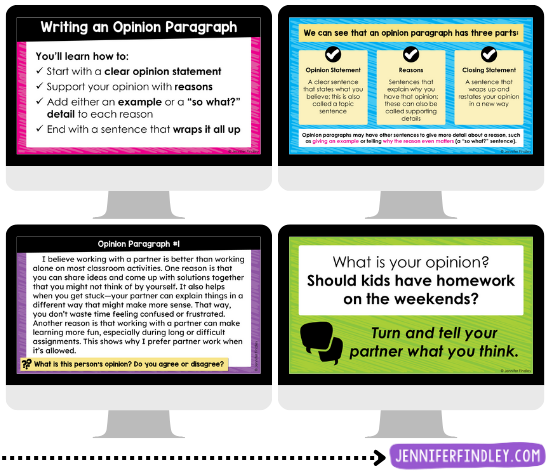
Once you’ve laid the groundwork with sentences, explicitly teach basic paragraph structure (topic sentence, supporting details, closing sentence).
Start with low-barrier prompts (i.e., prompts that require no background knowledge). This helps students focus on structure without being held back by content gaps.
If students need additional support with paragraph writing, I recommend teaching paragraph types. This will help you reinforce the structure as well as the purpose of different paragraphs (to share an opinion, to compare and contrast, etc).
You have two options for teaching specific paragraph types:
- Extend your paragraph unit timeframe and teach the types.
- Teach paragraph types as they align with your genre units. For example:
- Descriptive paragraphs before a narrative essay unit begins
- Opinion paragraphs before persuasive writing
- Cause/effect, compare/contrast paragraphs, etc. before informational writing
Integrating Paragraph Writing Across Content Areas
Here are ways to integrate paragraph writing into your content areas:
In Science:
- Explanation paragraphs after completing an experiment
- Cause and effect paragraphs to show what happened and why
- Compare and contrast paragraphs about two processes (e.g., evaporation vs. condensation)
In Social Studies:
- Opinion paragraphs after exploring two sides of a historical issue
- Perspective paragraphs written from the point of view of a historical figure or group
- Cause and effect paragraphs about key events
- Problem and solution paragraphs about historical conflicts
Support students with…
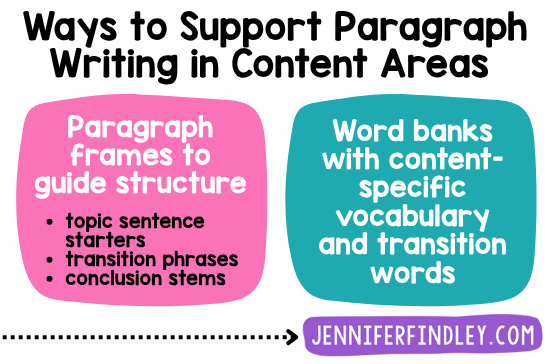
- Paragraph frames to guide structure (e.g., topic sentence starters, transition phrases, conclusion stems)
- Word banks with content-specific vocabulary and transition words
Build Toward Essays: Genre by Genre
Move into essays one genre at a time: Narrative → Persuasive → Informational is the recommended sequence I used. Teaching informational writing last allowed me to ensure that my students had lots of content knowledge to use in their writing.
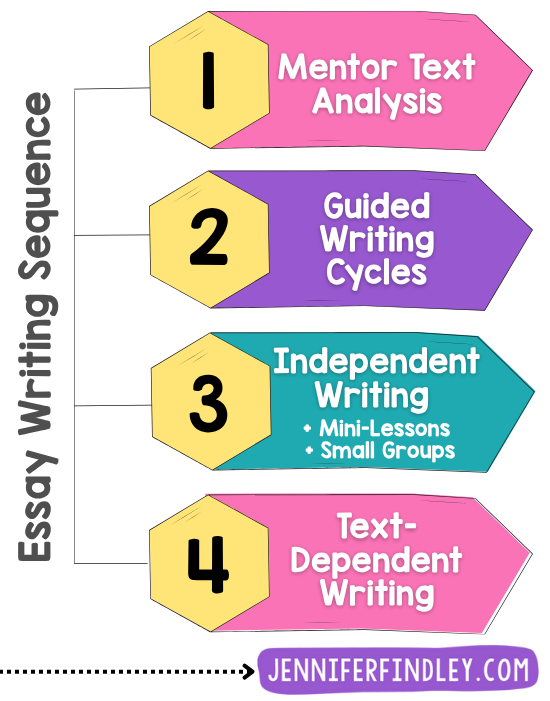
This is the sequence I follow with essay writing.
- Mentor Text Analysis – Analyze what makes the writing strong.
- Guided Writing Cycles – Plan and draft an entire writing piece together with lots of sharing, feedback, discussion, and explicit instruction. Depending on how the students do with the first cycle of guided writing, this can be repeated before moving into independent writing.
- Independent Writing + More Lessons + Small Groups – Students write on their own with continued mini-lessons. You can also pull targeted small groups for additional instruction during this time.
- Text-Dependent Writing – As soon as the students have shown they are ready, pull in text-dependent writing. Don’t rush to text-based writing just because that’s how students are assessed. A strong foundation with non-text-dependent essays will make a huge difference when you do get there.
Throughout essay instruction, lessons (strategy and revision lessons) should continue focusing on the sentence and paragraph levels.
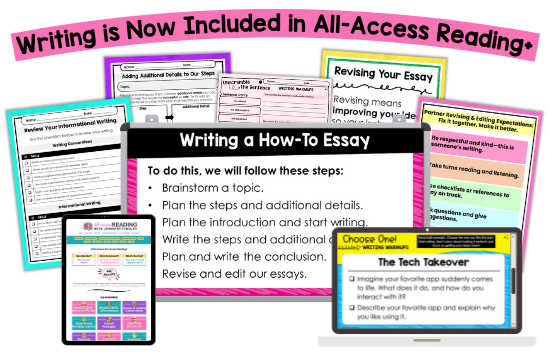
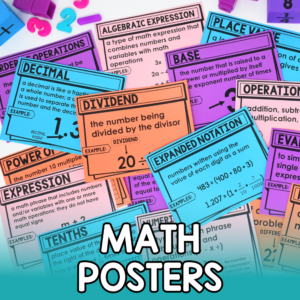
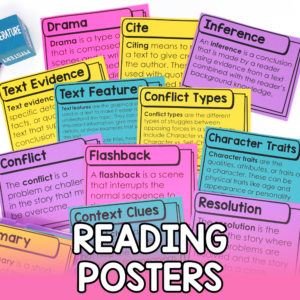
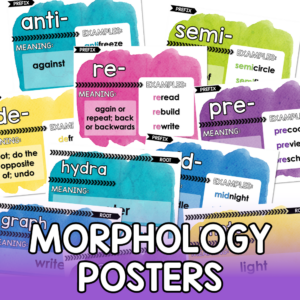
Have you heard the news? Writing has been added to All-Access Reading+! Inside the membership, you will get resources to support your instruction at the sentence, paragraph, and essay levels! Click here or on the image to check out the membership for all your literacy needs!
Want more free writing support for your 4th and 5th graders?
If teaching writing in 4th and 5th grade is difficult for you, you’re not alone. It’s really that hard, and I’d love to continue supporting you. Get your hands on my free writing toolkit to help you with pacing, procedures, and engagement. Click here or on the image to access it now!

Leave a Comment