

The Real Question We All Ask
You know the feeling. You’ve pulled a small group, the kids are in front of you, notebooks are out, and then it hits:
“Okay…what do I even do with them right now?”
Do I reteach the whole lesson? Do I just throw more practice pages at them? Do I go step by step again?
Small groups can so easily turn into mini whole-group lessons or, worse, a block of time you just try to fill. And that is not what our students need.
That’s where the Four Game Plans come in.
Why Game Plans Work
Every small group you ever teach in math is going to fall into just four buckets. This is good news because it’s not a million, it’s not 15, it’s just these four.
When you know these game plans, you’ll know how to spend the next 20 minute block. You won’t waste time guessing or panicking because you’ll know exactly which game plan to pull based on what you see your students doing.
A High-Level Look at the Four Game Plans
So, what are the game plans? Here’s the quick view:
- Fix-It Game Plan: When kids are all over the place and you’re not sure what’s going wrong
- Target Game Plan: When you already know the exact piece they keep messing up
- Concept/Context Game Plan: When kids can “do steps” but don’t actually understand what they mean, or when they are missing conceptual foundations that block the procedure
- Fluency Game Plan: When kids basically get it but need more practice to get smooth and confident
That’s it. Just four game plans. And the best part? Every small group you’ll ever teach fits into one of these.

Now let’s break them down one by one.
1. Fix-It Game Plan: Triage in Real Time
This is your front door. You pull students when you can tell something is off, but you don’t yet know why.
Maybe their work is all over the place. Maybe they’re guessing and hoping for the best. Maybe they’re skipping steps without realizing it.
In a Fix-It group, you sit with them and work through a problem together. Your job here isn’t to reteach the whole thing. It’s to listen and watch where they stumble. Sometimes the Fix-It time is enough. Other times, it shows you exactly what they need next: a Target group, a Concept/Context group, or a Fluency group.
Example in action:
- You pull a group for multi-digit division because their work is chaotic, and you don’t really know what the issue is.
- In the Fix-It group, you walk them through one problem.
- As you go, you notice patterns: some students don’t know how to use multiplication to get started, some are subtracting wrong, and some don’t understand what the quotient even represents.
- That tells you their next step.
2. Target Game Plan: Zoom in on the Subskill
This type of small group game plan is when you already know the exact choke point that’s holding your students up. You don’t need to reteach the whole process. You just need to zoom in on this specific subskill that you’ve noticed.
Examples:
- In fractions, maybe they can’t find common denominators.
- In division, maybe they keep subtracting from zeros incorrectly.
- In decimals, maybe they always misalign the digits.
- In order of operations, maybe they always add before multiplying.
In a Target group, you hyper-focus on that one subskill. That might mean giving them a strategy or trick to help them remember it, modeling a workaround they can use, or bridging a piece of conceptual understanding that’s causing the breakdown. It’s precise teaching, not drill-and-kill.
3. Concept/Context Game Plan: Build the Why
This group is about understanding.
You pull a Concept/Context group when:
- Students can do the steps but don’t really understand what the math means. They fall apart when it’s a word problem or when they have to explain their thinking.
- Or students are missing a foundational conceptual understanding that is blocking their ability to learn the procedure in the first place.
What it looks like:
- Use models, manipulatives, or visual representations.
- Layer in real-world contexts to show why the math makes sense.
- Always bridge back to the procedure so they can transfer the understanding to paper-and-pencil math.
Examples:
- Division with remainders → act it out with trays of muffins to show what the remainder means.
- Multiplying fractions → use an area model to prove why the answer gets smaller, then connect it back to the multiplication steps.
- Order of operations → solve a problem two different ways and compare the answers to show why order matters.
4. Fluency Game Plan: Reps for Smoothness
Sometimes the issue is not the steps or the meaning. It is the execution. Students understand what to do, but their work is slower, inconsistent, or marked by small slips and errors that are not tied to conceptual or procedural understanding.
That is when you pull a Fluency group. The purpose is practice: short, intentional rounds with feedback to build smoothness, accuracy, and automaticity. The goal is focused practice that helps students work with more ease and accuracy.
Examples:
- Multi-digit multiplication → students know the algorithm but work slowly and lose accuracy even though the steps are correct.
- Decimal subtraction → students line up digits properly but make small, careless slips that are not about understanding the procedure.
- Division → students solve with the right process but take a long time to finish each problem
Why This Matters
The Four Game Plans simplify your small group planning.
Instead of thinking, “I have to reteach decimals again,” you think:
- Do they just need a Fix-It to see where it breaks down?
- Do I already know the Target subskill?
- Do they need Concept/Context to understand the why?
- Or is this just about Fluency to make it stick?
That shift saves you from wasting time reteaching entire lessons and gives kids exactly what they need.
Bringing It All Together
Let’s put this into real classroom terms:
- Multi-Digit Division → If they’re lost all over, start with Fix-It. If they’re subtracting wrong, run a Target group. If they don’t understand what the quotient means, they need Concept/Context. If they’re slow but basically right, that’s a Fluency group.
- Adding Fractions with Unlike Denominators → If the whole thing is a mess, Fix-It. If it’s just denominators, Target. If they don’t understand why denominators need to match, that’s Concept/Context. If they’re slow and messy but correct, Fluency.
- Order of Operations → If work is all over the place, Fix-It. If they always add before multiplying, Target. If they chant PEMDAS but don’t really understand, Concept/Context. If they’re accurate but drag through every problem, Fluency.
Wrap Up
Small group math doesn’t have to feel overwhelming. It’s not about reteaching the whole lesson or reinventing the wheel. It’s about knowing which game plan your kids need right now.
Four game plans. Twenty minutes. A clear purpose every single time.
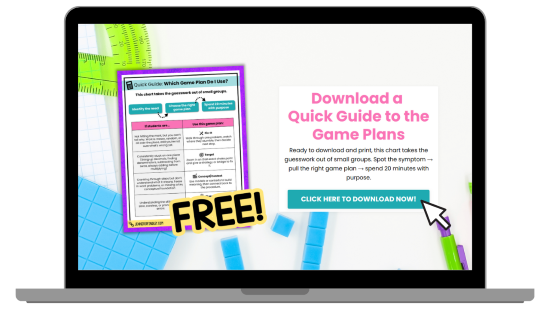
Get a Quick Reference Guide
This chart takes the guesswork out of small groups.



Leave a Comment