

You’ve been told to teach morphology or maybe you see the power yourself and know it would help your 4th and 5th graders. But here’s the problem: no one gave you a clear roadmap for how to teach it in a way that actually gets results.
This post shares a simple 6-step system you can use all year. It’s flexible (go as slow as you need, as fast as you can), and it actually works.
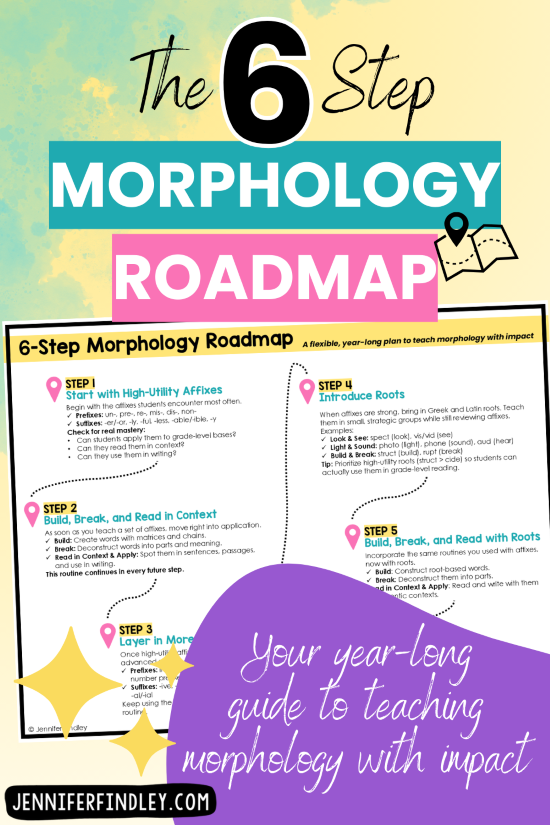
Step 1: Teach the Affixes Students Need
Start with the affixes that show up the most in grade-level reading and writing.
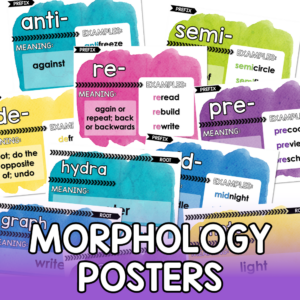
Prefixes: un-, pre-, re-, mis-, dis-, non-
Suffixes: -er/-or, -ly, -ful, -less, -able/-ible, -y
Yes, many of these were introduced in K–3, but you can’t skip this step. The question isn’t have they seen them before? It’s can they actually use them now?
The real test is:
- Can students apply them to grade-level bases?
- Can they read them in context?
- Can they use them in writing?
Lots of students can parrot “un- means not.” But can they decode unhelpful while reading? Can they write it correctly in a sentence? That’s where the impact is.
Step 2: Get Them Building & Breaking Words (and Reading in Context)
After teaching a chunk of affixes, move straight into application. The sooner students use and read them in context, the faster they stick.
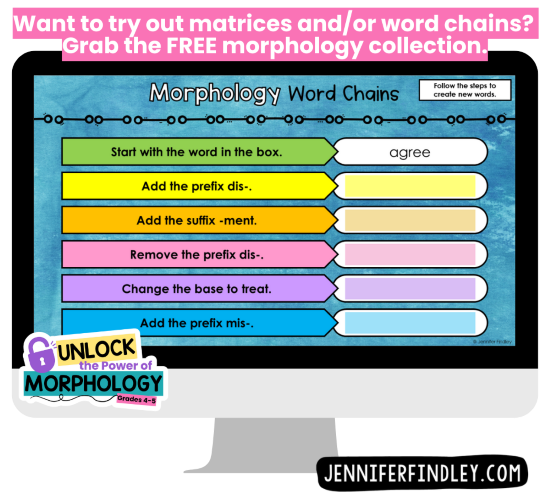
Build: Use word matrices (put a base in the middle and add affixes to create new words).
Break: Implement word chains (swap prefixes or suffixes to see how meaning shifts).
Read in Context & Apply: Highlight words in sentences or passages, analyze how they work, and try writing them in original sentences.
Tips:
- Keep activities short but frequent. 5-10 minutes a day works wonders.
- Start with bases students already know so the focus stays on the morphology.
- Rotate activities (matrix, chain, reading) so students see affixes in different contexts.
- Push into reading and writing quickly. Students should read words in sentences, paragraphs, and passages and try writing them in their own texts.
This is the step where the lightbulbs go off. Students stop memorizing definitions and start seeing how words actually work.
Step 3: Add More Affixes (Keep the Routine Going)
Once high-utility affixes are solid, layer in more advanced ones. Teach them in groups by meaning (prefixes) or parts of speech (suffixes). This speeds up instruction and helps students retain them.
Prefixes: in-/im-/ir-/il-, over-, under-, ex-, de-, number prefixes
Suffixes: -ive, -ous, -ion, -ment, -ness, -ic, -ish, -al/-ial
Keep using the Step 2 routines with these new affixes. Construct, deconstruct, and read in context. That cycle never stops.
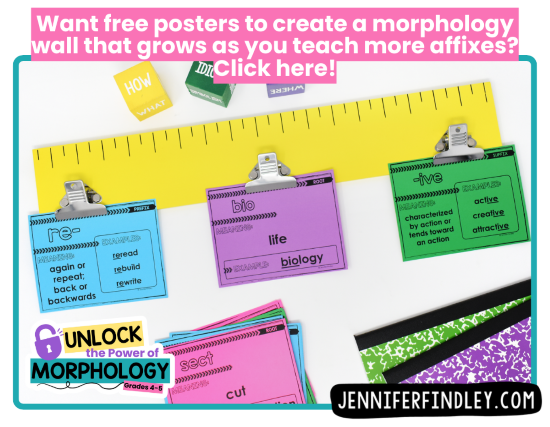
Step 4: Bring in Roots That Unlock Meaning
Once students have a solid affix foundation, begin teaching Greek and Latin roots. Roots carry the core meaning of words, and when paired with prefixes and suffixes, they multiply what students can decode, understand, and use.
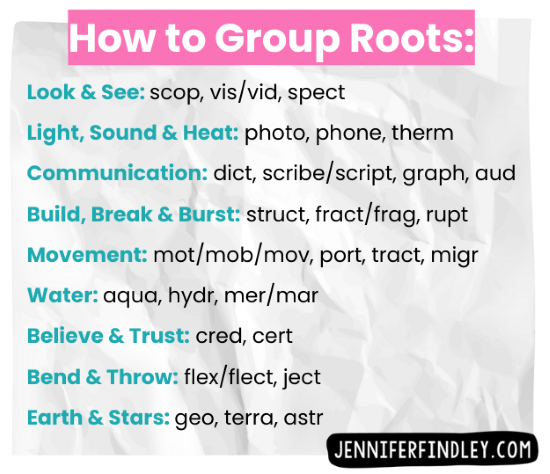
Group roots strategically to speed up mastery. Example of how to group:
- Look & See: scop, vis/vid, spect
- Light, Sound & Heat: photo, phone, therm
- Communication: dict, scribe/script, graph, aud
- Build, Break & Burst: struct, fract/frag, rupt
- Movement: mot/mob/mov, port, tract, migr
- Water: aqua, hydr, mer/mar
- Believe & Trust: cred, cert
- Bend & Throw: flex/flect, ject
- Earth & Stars: geo, terra, astr
Tip: Choose high-utility roots to prioritize. For example, struct (build) will appear often across grade-level texts, while cide (kill) is less frequent. Focus on roots students will actually see and use.
Step 5: Use Roots in Real Reading and Writing
What do we do with these roots? You do the same things you did with affixes back in Step 2, just now with roots.
As soon as students are ready, have them:
- Build: Construct new words using roots + affixes.
- Break: Deconstruct root-based words into their parts.
- Read in Context & Apply: Spot and analyze words with roots in sentences and passages across subjects. Write sentences using words with roots correctly.
Don’t stop at the surface. Spend time unpacking how the root shapes the meaning of the whole word. For example:
- Port in reporter → someone who “carries back” information
- Rupt in interrupt → to “break into” something
Roots can feel more abstract than prefixes and suffixes, so it’s worth slowing down here.
Finally, don’t miss the cross-curricular gold. Roots naturally tie into science and social studies vocabulary (bio = life, geo = earth). Look ahead at your content areas and weave those connections in so morphology instruction feels authentic, not isolated.
Step 6: Keep Growing With Spiral Review
Once affixes and roots are in play, keep adding advanced morphemes tied to grade level, curriculum, and student curiosity.
Always cycle back to the build–break–context routine. That’s what makes morphology stick long-term.
Ready to Go All In on Morphology?
The FREE Morphology Collection is packed with ready-to-use activities and resources that make morphology engaging and effective. Teachers rave about how much is inside.
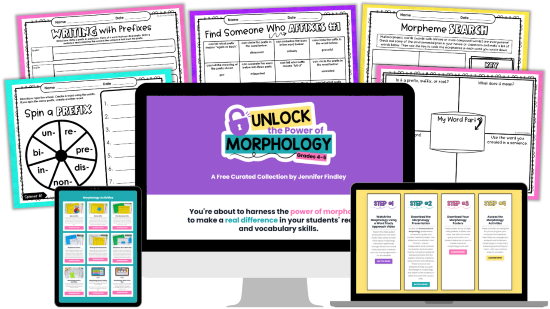
👉 Click here to get instant access.
Want the Full Experience?
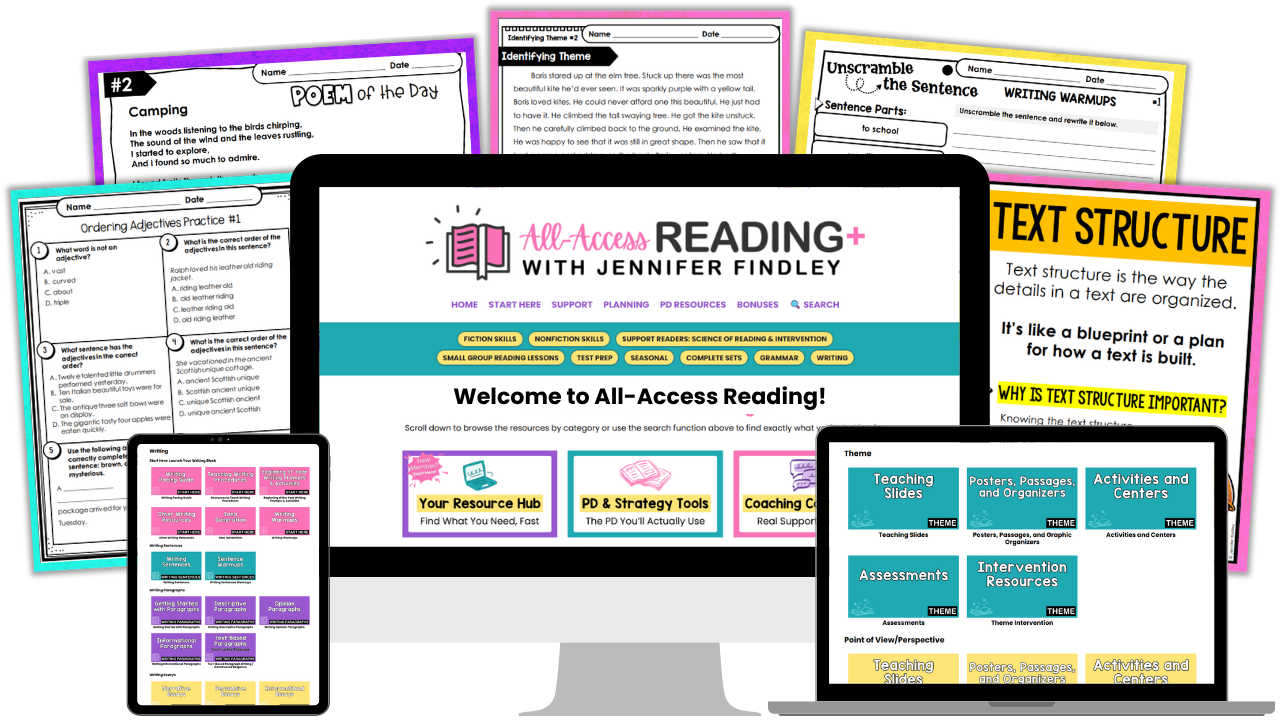
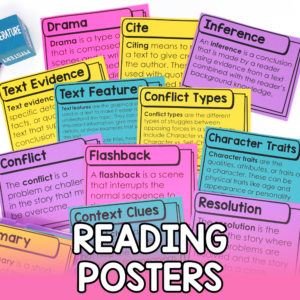
The collection gets you started. The All-Access Reading+ membership gives you everything — full teaching slides, small group lessons, passages, matrices, chains, sorts, and more.

👉 Click here to join and see why teachers never want to leave.





Thank you for this helpful tool.