

Word problems don’t usually fall apart during the calculations.
They fall apart before the math even starts.
Students read the question, grab the numbers, and jump straight into solving. Suddenly, the work turns into guessing, rushing, or trying operations that don’t actually match the situation.
If you’ve ever looked at a student’s work and thought, “They can do the math… so why doesn’t this make sense?”—this routine is the missing layer.
Restate. Equation. Solve. Answer.
It’s simple on the surface, but each step is doing very specific thinking work for your students. In this post, I’ll break down how the routine works, why it supports real problem solving (not just writing sentences), and how it grows with your students over time.
The Routine
Restate the question.
Write the equation.
Solve the problem.
Answer the question.
Restate. Equation. Solve. Answer.
Step 1: Restate the Question
This is where comprehension happens.
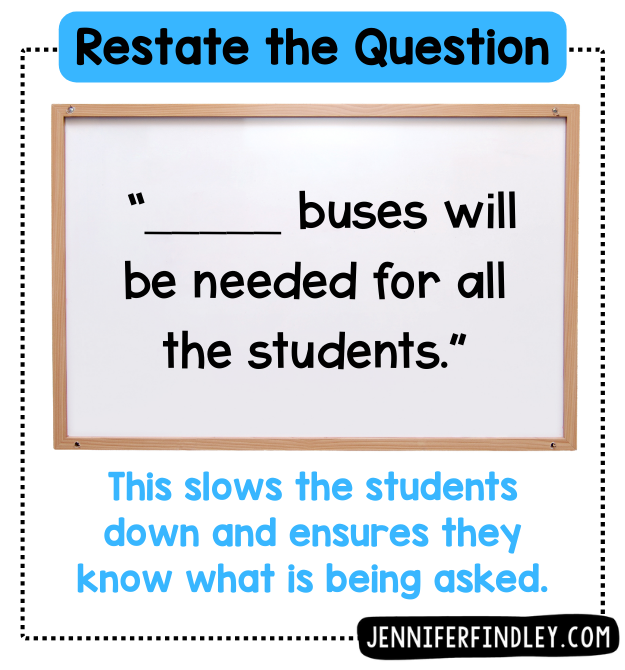
Before students touch the numbers, they restate the question as a complete sentence and leave a blank where the answer will go.
This first step is important because:
- If a student can restate the question, they understand what’s being asked.
- Leaving a blank forces them to think about what kind of answer they’re looking for.
- It slows down impulsive problem solvers who want to jump straight to computation.
If the question is:
How many buses are needed for all the students?
Students might write:
- “_____ buses will be needed for all the students.”
- “A total of _____ buses will be needed.”
There is no single “right” sentence. What matters is that the sentence makes sense, matches the question and context, and the blank is in the correct spot.
This step gets students thinking: What am I actually trying to find?
Step 2: Write the Equation
This is where decision-making happens.
Now students decide what math the word problem or situation calls for.
They:
- Choose the operation by matching it to the context of the problem, not keywords.
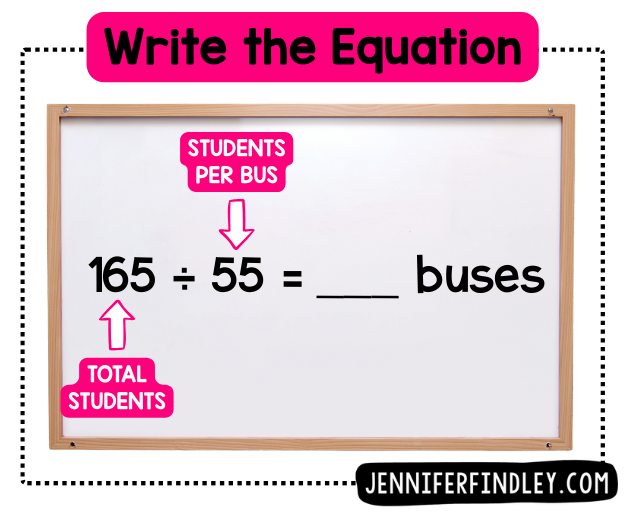
- Write the equation.
- Label the numbers in the equation to connect them back to the context.
This step, especially the labeling aspect, is important because it makes the students consider what the numbers really mean and how it connects to the operation.
This step is about setting up the math correctly, not solving it yet.
Step 3: Solve the Problem
This is where strategy lives.
Now students solve the equation using an appropriate method.
That might be:
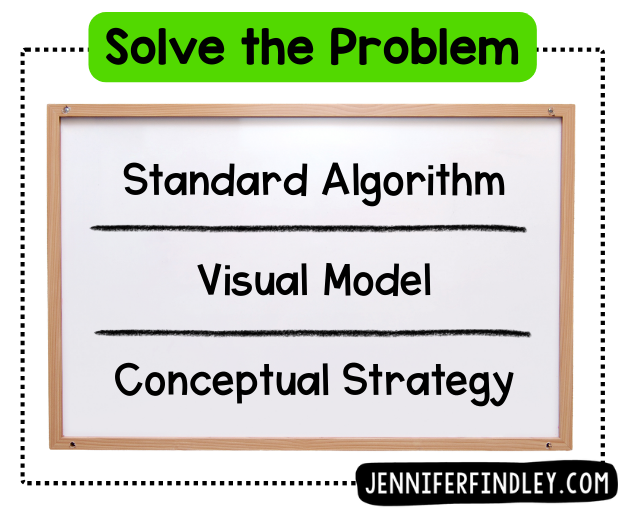
- An algorithm
- A strategy (partial quotients, breaking apart numbers, etc.)
- A model (area model, tape diagram, number line)
This step is important because it allows students flexibility in how they get the answer. It also makes it highly compatible with abstract math that uses algorithms and conceptual math that uses visual models.
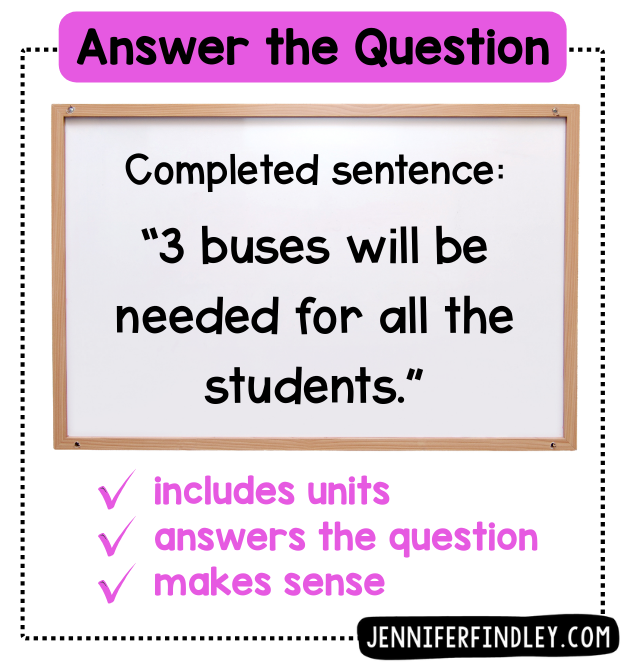
Step 4: Answer the Question
This is where meaning is checked.
After solving, students:
- Label the answer with correct units.
- Put the answer back into the original sentence.
- Read it to see if it makes sense.
This step forces them to ask:
- “Does this answer actually match the question?”
- “Does it make sense in this situation?”
Why This Comes Before Explaining and Justifying
Before students can explain their thinking, they need thinking that actually makes sense.
If students don’t fully understand what the problem is asking, why they chose a certain equation, or whether their answer fits the situation, asking them to explain or justify just turns into guessing at sentences.
This routine builds that foundation first.
Students learn to figure out what they’re solving for, connect the numbers to the situation, and finish the problem in a way that makes sense, not just stopping when they get a number.
Then, when you add explaining and justifying later, students aren’t trying to come up with something to write. They’re simply putting words to thinking they already understand.
What Comes Next
Once students are used to Restate. Equation. Solve. Answer., you can start adding explaining and then justifying.
If you want to keep building from here, these posts show what that next step looks like:


Really useful information here. Thanks for putting this together!